I look around the café. It’s four tables, and all are occupied by crew members. It seems on this train, the crew claims the café for their private club, and coach passengers have to eat in the diner, which means they must wait for the first class to finish.
Here the dining is lower than fast food, maybe movie theater food. Microwaved hamburgers, that sort of thing. I line up, order at the counter, and carefully carry my food back to my table in a little paper box. But, in my breakfast box, I also have a nip of vodka and a bottle of orange juice. I’m going to make it.
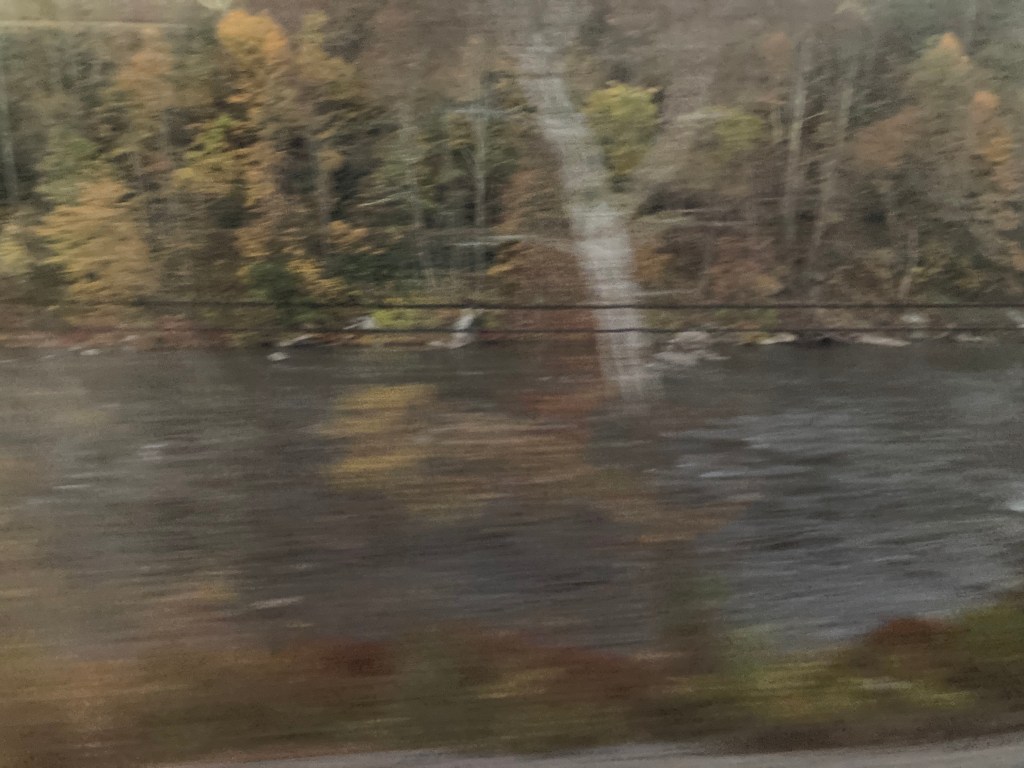
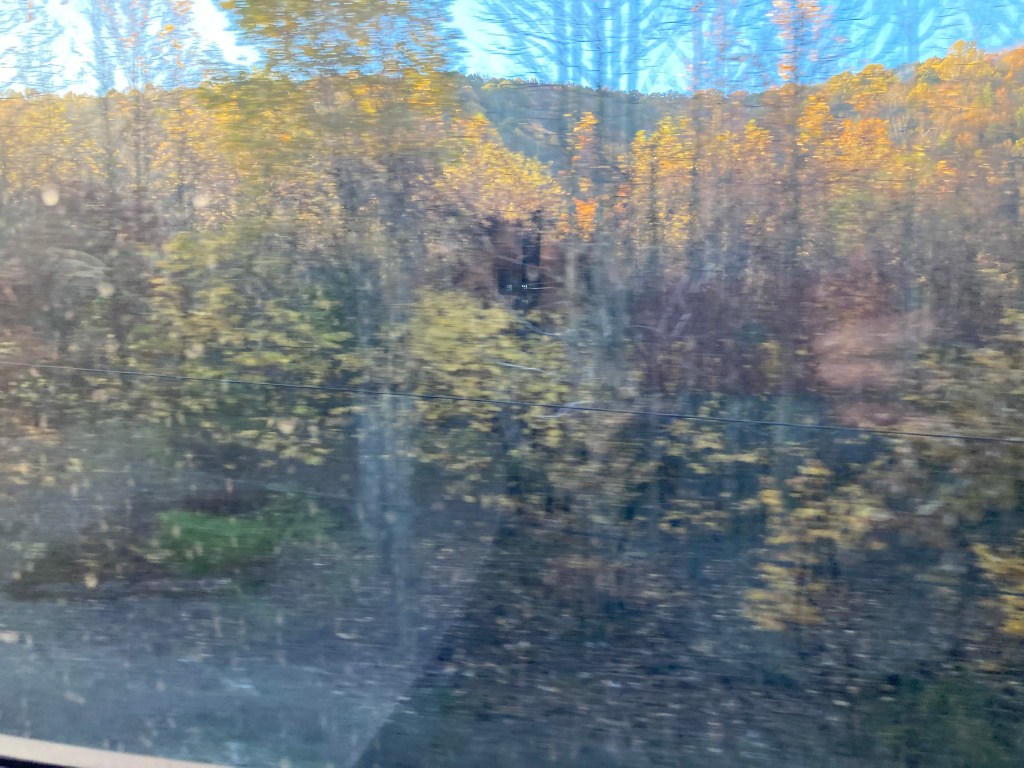
I sit at my breakfast table, watching the foothills of the Alleghany Mountains roll past. The trees are gorgeous in yellows and oranges. I try to get a few pictures, but many are blurred by the motion,
I’ve moved all my things to the open seats, just outside the diner. I pass through the crew’s café, through the shifting coupling between the cars, and to my seats. I’m feeling pretty ragged after two nights of short sleep.
I think about the train change in Washington. I’m going to have to get my checked bags and carry them to the Acela. I’m a little worried. But, it will work out.
Sunup in the Alleghany foothillsFrom my breakfast table, the passing scene rolls swiftly past.From my breakfast table, the passing scene rolls swiftly past.
The Capitol Limited will take me to Washington, D.C. The train is longer than the Texas Eagle– three or four sleepers and at least as many coaches. Still just one café car.
Riding coach.
I’m in one of the coaches. The seats are comfortable enough for sitting or reclining. They are marginal for sleeping.
When we board, about 6 pm the dining car is closed. The coach attendant says there will be an announcement when the diner opens. After two hours, I walk back to the diner. The cook explains they are busy serving the sleepers first, then they will open to coaches.
At last the café opens at 9:45 pm. I order a hot dog and eat it slowly, reading the news. I make a few notes.
Back in my seat after a quick supper, I lie back and think about sleep. I’m uncomfortable. The head rest meets my head wrong, and my neck bends awkwardly. There are no amenities in coach any more. No heat, no blankets, no pillows. I could bring a blanket and pillow, but that would require another piece of luggage.
I can’t get comfortable. I quickly give up on sleep.
I look out the window into the blackness. I see scattered lights shining down on isolated houses. I’m near Lake Erie. I see moon reflected in wide waters.
I write in my journal. I pull out the ipad and start figuring out alternate train routes, combined train and plane routes.
Eventually I walk back to where there are two open seats together. I lie down across them, squirm around, and fall asleep.
At last, the sun rises. I stretch and drag myself back to the cafe.
Breakfast in the café car on the Capitol LimitedMenu in the café car on the Capitol Limited.
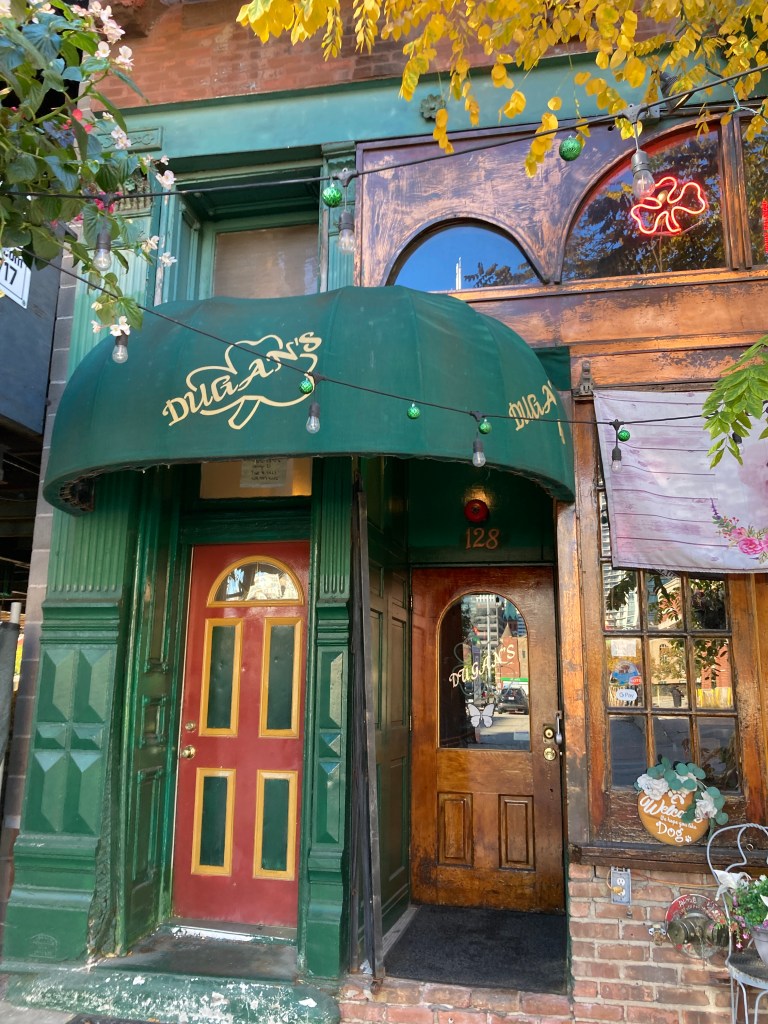
From the pocket device, I see that there is a pub named Dugan’s nearby. I walk east. It’s a pleasant, comfortable place.
A long brick box stretches back from the front window and door. In the front half of the bar, an island bar holds the middle of the space. In back, people sit at tables and chairs. Mia, the barmaid, is nervous on her first day at work. Couple by couple, the bar begins to fill. The sound of talk and laughter fill the air. Mia is busy, animated.
A few months ago in Chicago, I walked north, to Dylan’s. It was more wood than brick.
Dugan’s Pub in the afternoon before the happy hour rush.
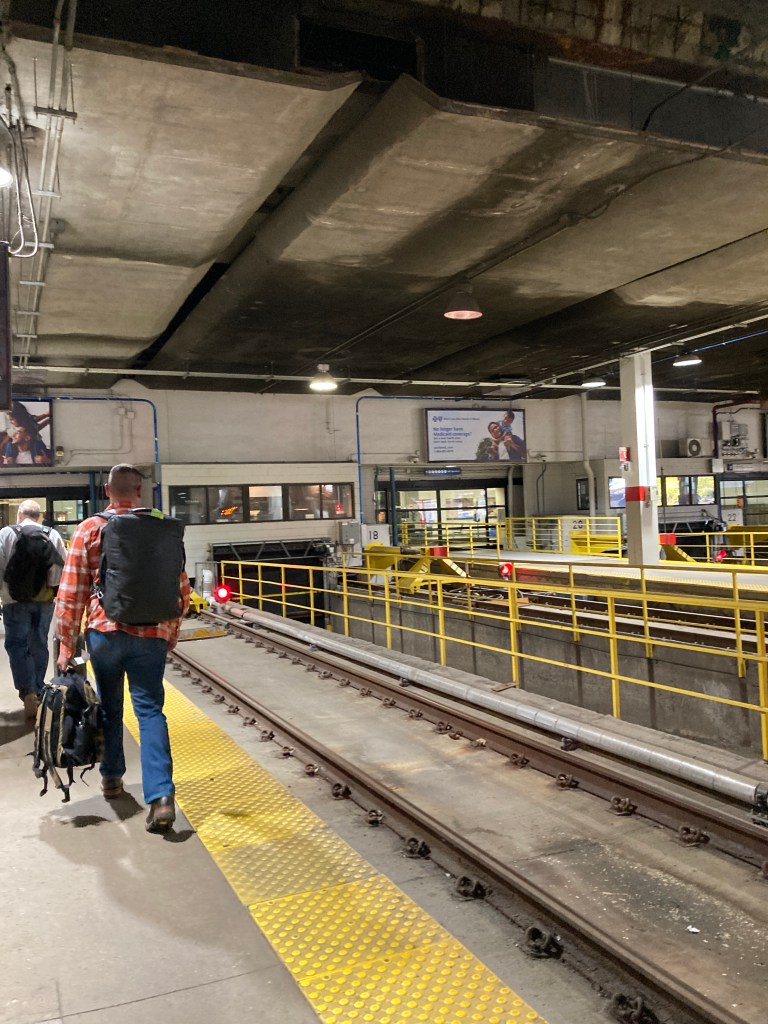
We enter the station through the railyard, which is dug under the station in a cavernous enclosure. All the surfaces are raw concrete and steel. They look dirty, except the platform.
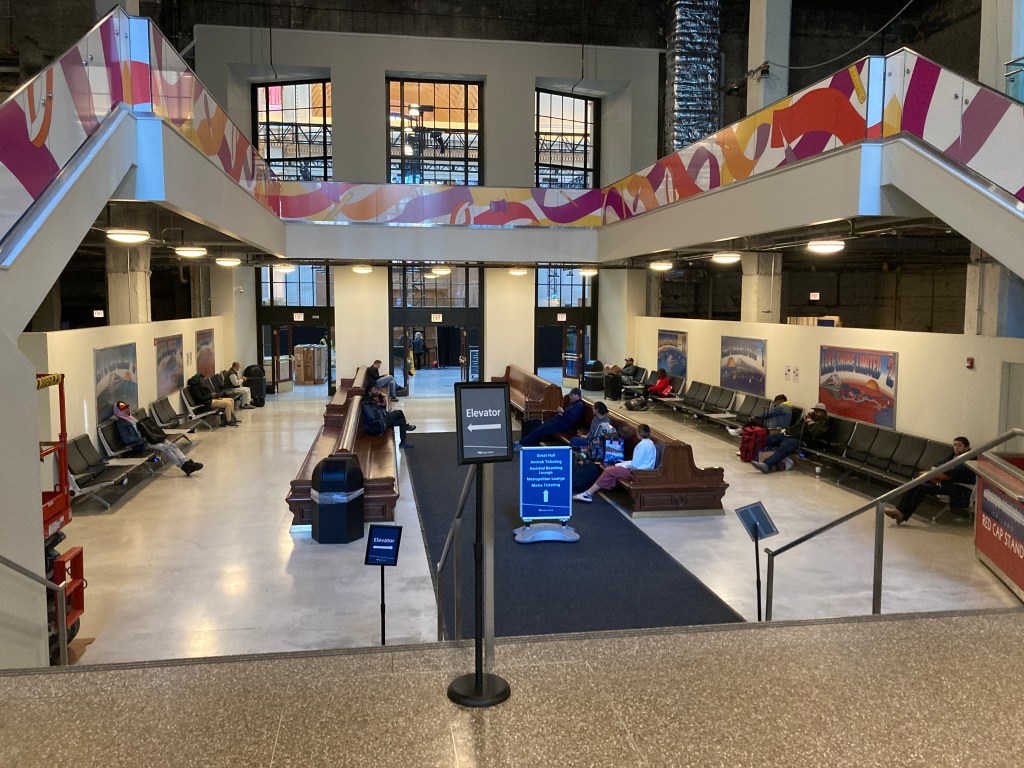
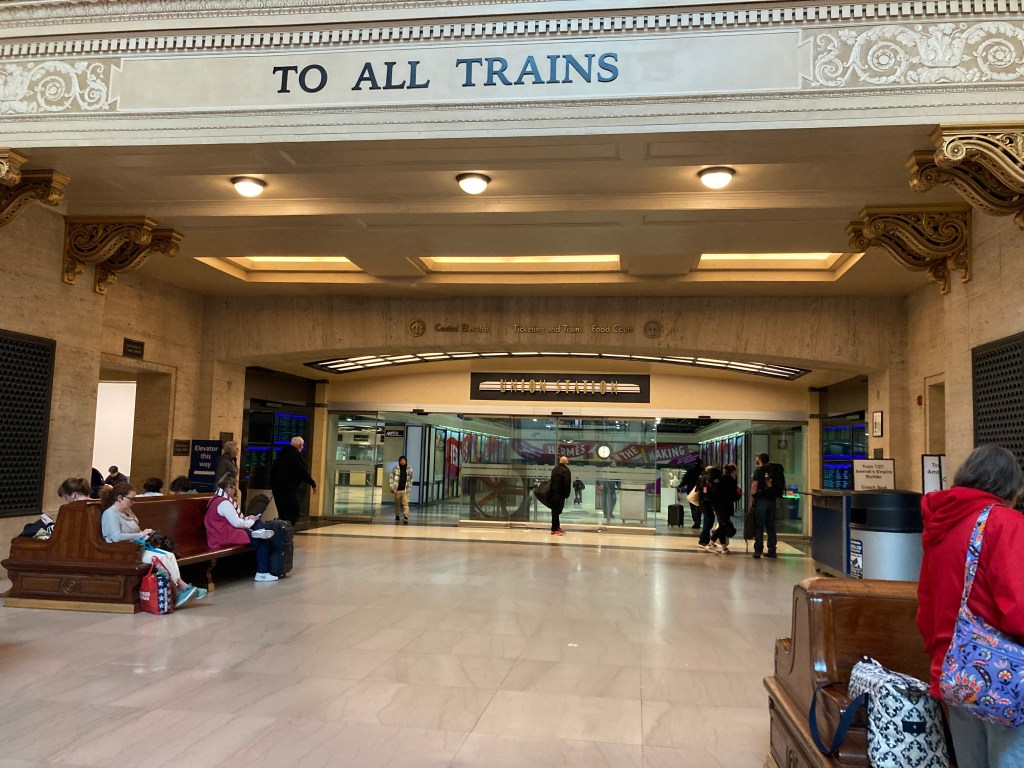
Above, the station is a grand old building that management is struggling to maintain. Lofty ceilings curve over a tile hall with comfortable wooden benches. Now I know my way to the Metropolitan Lounge.
I check into the Lounge at the reception desk. I turn right to leave a bag in the storage room. Then back around front and over to the lounge area.
The main room stretches back, and generous side rooms open on each side. An open staircase descends from above. Soft jazz plays.
A refreshment counter offers free snacks and drinks. A cash bar is tucked under the stairs.
People sit at tables, sit on couches, lie on couches. This a place for relaxing.
I have about six hours to spare.
The underground railyard at Chicago Union Station greets passengers with raw concrete and steel.Metropolitan Lounge is a refuge for first class passengers.View from the street entrance looks to a concourse at the train station.Arched windows over a concourse to the rail platforms.Conourse leading to the railyard is broad with a classic look.Passengers all down the underground platform toward the train station.
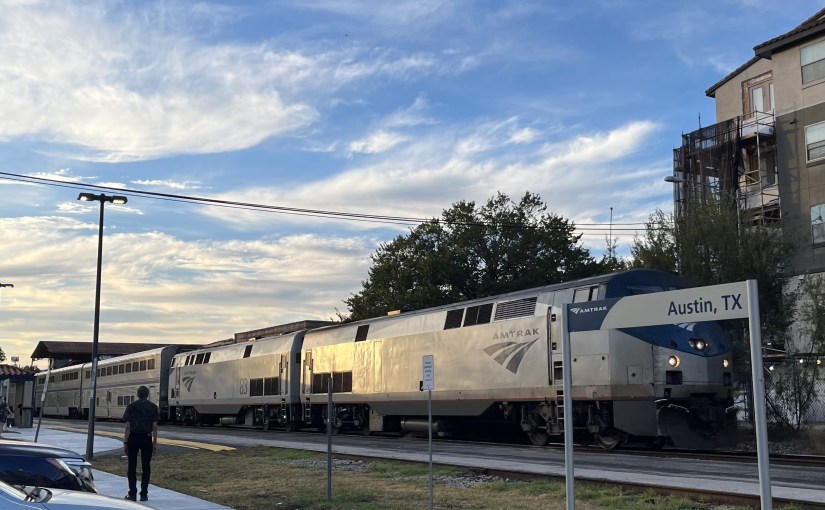
Austin station is an insult to train riders. This is what you get from a city that gives endless lip service to public transit, but does very little about it. It’s on the edge of downtown, but it’s hidden away up a hard-to find dead-end street behind the YMCA. The station itself is underwhelming, with a small inside waiting room and not even the most basic food services.
As we roll north, the conductor announces the stops. Most are quick. At some, through-passengers are allowed to get off, stretch their legs, and breathe fresh air or have a smoke. The conductor offers a wry caution, “When all aboard is called, enter the train. If you are not on the train when the train leaves the station, you will be left. That’s all right, you can catch the next train tomorrow.”
At Dallas Union Station, I get off to stretch my legs. The trainside walkways are pretty nice, red brick edged by that yellow bumpy caution strip. Little canopies are spaced down the middle. There are several sets of double tracks. If I walk down a way, I can get a look at the station building, brick painted while. A walkway crosses all the tracks and leads to the station, but I don’t want to leave trainside.
At St. Louis Union Station I get off again. The trainside platform is bare concrete with the yellow edge, but it’s clean. The tracks are out in the open air, under the sky. A hulking skyway rises from the platform and crosses other tracks, crosses car traffic, ducks under a raised highway, and disappears.
Dallas Union Station beside the tracks.
Boarding platform at Dallas Union StationPedestrian bridge to St Louis Union Station
In the morning, about 5:30, I head down to the diner. Walt has an urn of coffee made at a little station by the stairs, and I draw some into a paper cup as I pass. The kitchen won’t be open until 6:30.
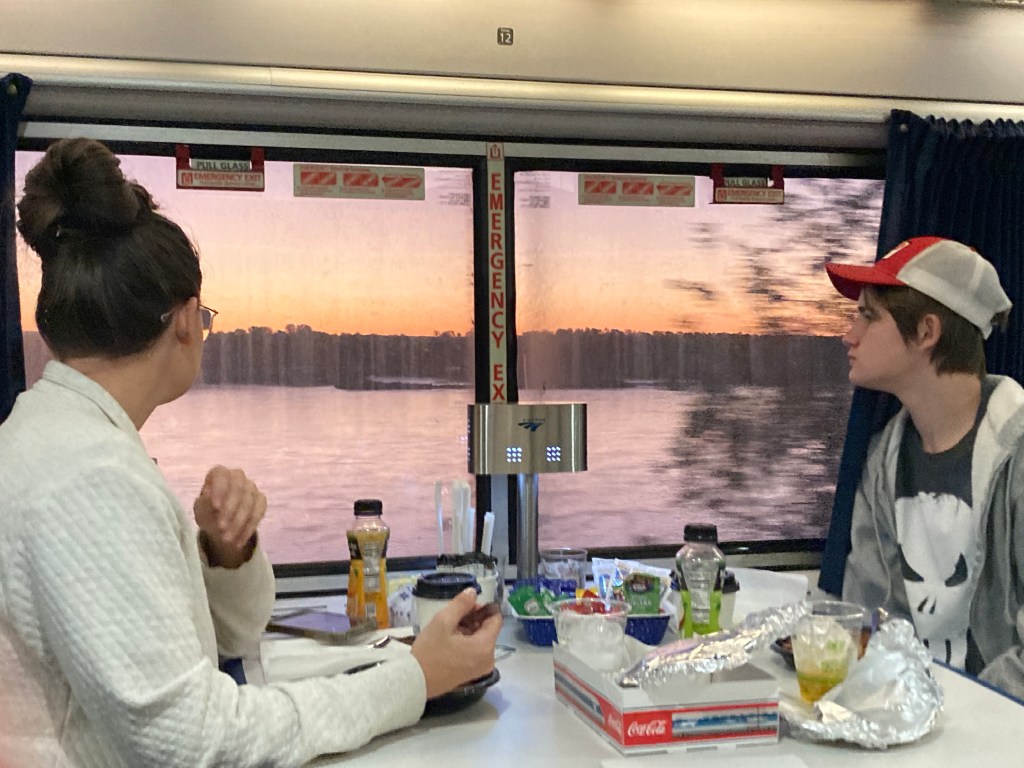
In the diner, I sit down at a table to read the news. Out the windows to the east, the sun is rising over the Mississippi. The sky glows a soft orange.
Breakfast comes. I have an omelet, home fries, and sausage links. Not bad.
Todd and I talk about the state of the railroad and the way it got this way. For the first time in decades, there is hope. Amtrak Joe pumped a tank of billions into the system. A lot of deferred maintenance will be done, but more difficult is the restoration of a train industry in the U.S. after decades of underfunding.
Lately, during the pandemic, Amtrak cut operations way back. Then their parts suppliers went out of business. So now there are no parts to repair the trains. That’s no way to run a railroad.
After breakfast I retire for a respite in the room. I make some notes. I nap a little. I read a little. Soon I pick up the macbook and head for the diner.
In the diner, I find the table with my room number on a slip of paper and sit down. I have at least an hour until lunch. I open the macbook and start drafting.
Lunch was forgettable.
Amtrak took all the full-service diners off the trains during the pandemic. After the pandemic, Amtrak did not have enough cars to restore full dining to all trains. The Texas Eagle was one of the losers.
One thing, the food is plentiful. You won’t lose weight eating in first class.
Soon after I’m done, I have to vacate the table for the next hungry seating.
Back in my room from lunch, I read a little. Then I turn myself to organizing and packing for the train change.
I listen to crew members chat as they pack up their rooms. We’re near the end of the trip. Everyone on the crew is thinking of the chores they must do to shut down the train. Their paid time stops when the train stops. If they’re not finished with their chores, they will finish on their own time.
Goodbye again.
Sunrise over the water, looking out the diner window.Bags are lined on the the luggage shelves.
The Texas Eagle is a short train, one engine and four cars. Behind the engine comes the sleeper car, then the diner, then two coach cars. It runs from San Antonio to Chicago, one train each way, daily. The train usually runs full.
It runs full, because there is not enough rolling stock to serve demand. They can’t put another car on, because they don’t have one.
Major stops are in Fort Worth, Dallas, and St. Louis, with about two dozen others. The train runs slow because the tracks are not very good. Cell service is strong along the whole route.
Now and then throughout the day, the train pulls onto a sidetrack to let a freight train slowly pass.
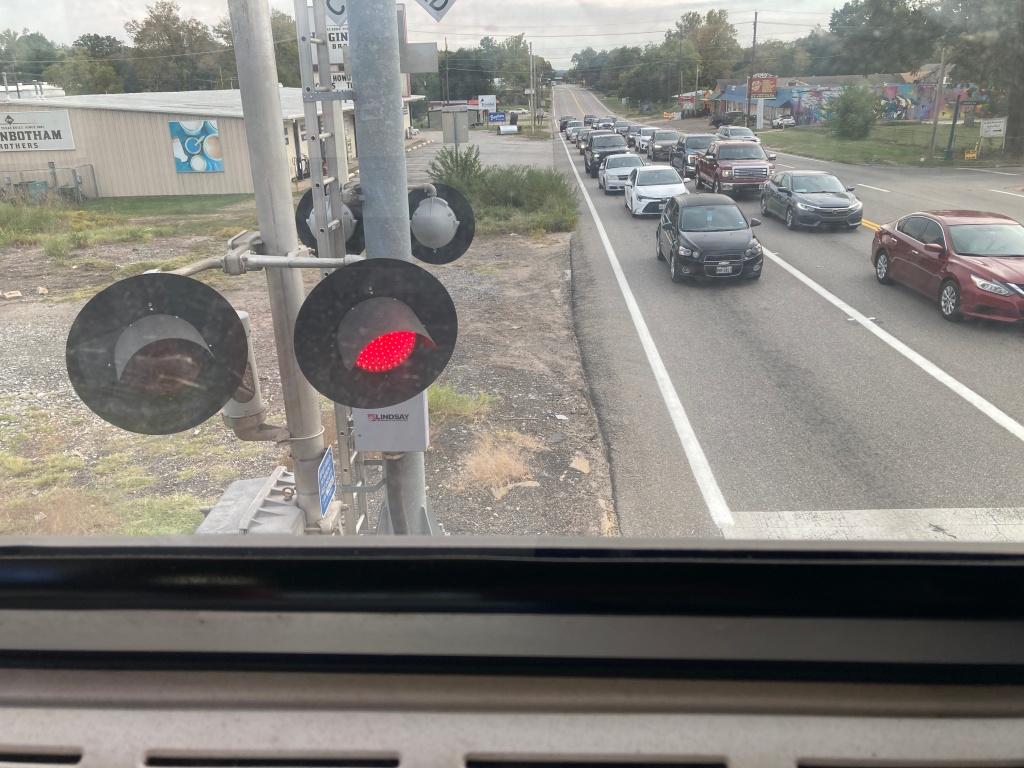
At one point, I look out and see that we are stopped across a street, and cars are stopped, waiting for us to pass. At first, I’m sorry, but then I remember how much cars have done to ruin transportation (and the environment) in America (and the world). Let them wait.
Last month I visited Providence, Rhode Island, getting to know the city. I plan to establish a summer home here next spring. I’ll keep my permanent residence in Austin, but I’ve had it with Texas summers.
I’m a climate crisis refugee. I was born and raised in Texas, and I’ve always been glad of my heat tolerance. I’m comfortable up to 95 degrees. But now we have two months of the year when the mercury shoots up past 100. I’m tired of hearing weather casters tell me not to go outside in the afternoon.
I’m not the first climate migrant. People fleeing drought and flood have been on the move for a generation. It’s global, but it has been mostly a third world movement. Now the first world is beginning to feel it.
It’s possible to ignore the rising heat if you live in air conditioned spaces. But you have to be content to give up summer afternoons. I’m not.
Ironically, that air conditioning that shelters us from the heat outside makes the heat outside worse. The air conditioners use power from plants that exhaust greenhouse gases. And the air conditioners themselves pump heat out to the air. It’s a positive feedback loop. The hotter the environment, the more we use the air conditioner. The more we use the air conditioner, the hotter the environment.
I’m moving away from that loop. Of course, there’s no real escape. There’s another effect. Providence is in the hurricane zone. And with the climate crisis, hurricanes are growing stronger and more numerous.
I took a riverboat tour on the Providence River. The captain told tales of hurricanes past, and he pointed to a gated flood barrier high enough to keep out the flood surge of the worst hurricane on record. But the storms are growing stronger. It’s only a matter of time until a storm surge overwhelms that sea wall. And then another. Then there will be a new wave of climate migrants. More people on the move.
But for now, Providence is a great little city.
(Photos by Robin Cravey unless otherwise noted).
Feature image above: Downtown Providence. Photo by Jeffee Palmer. The city seen from the river.
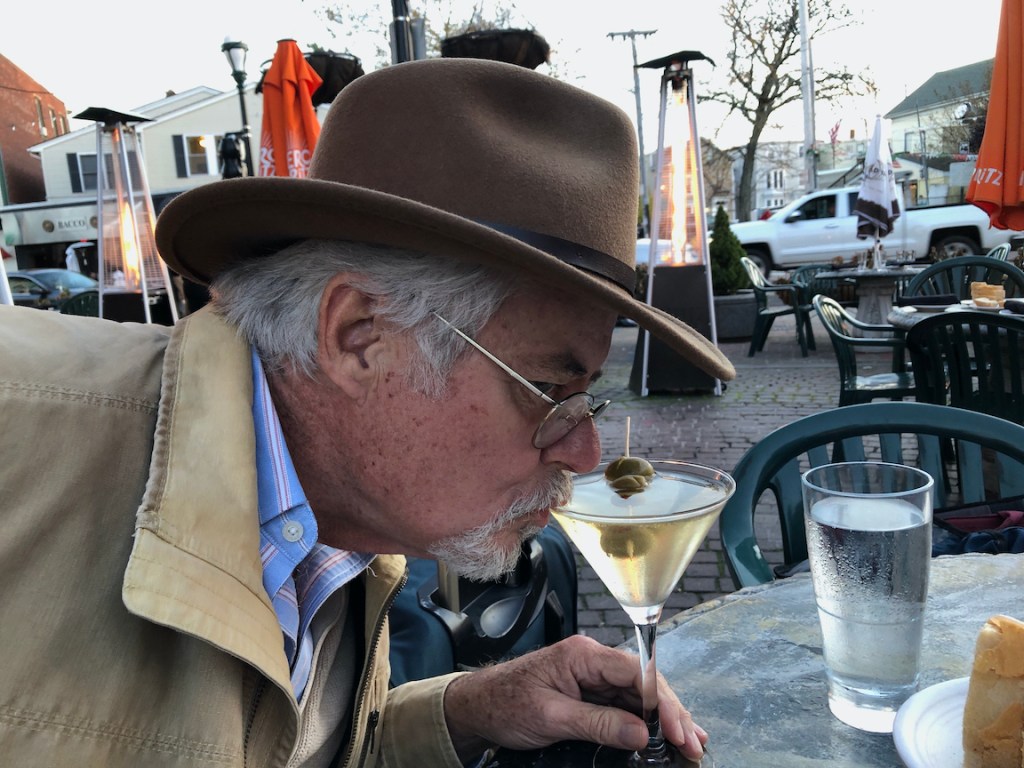
Venda Bar & Ristorante on Atwells St. in Federal Hill. The broad plaza next to the historic Italian eatery serves as an open-air meeting place and hangout. Their martinis are outstanding. Stretching away in either direction are blocks of old storefronts offering bars, restaurants, and Italian delis.
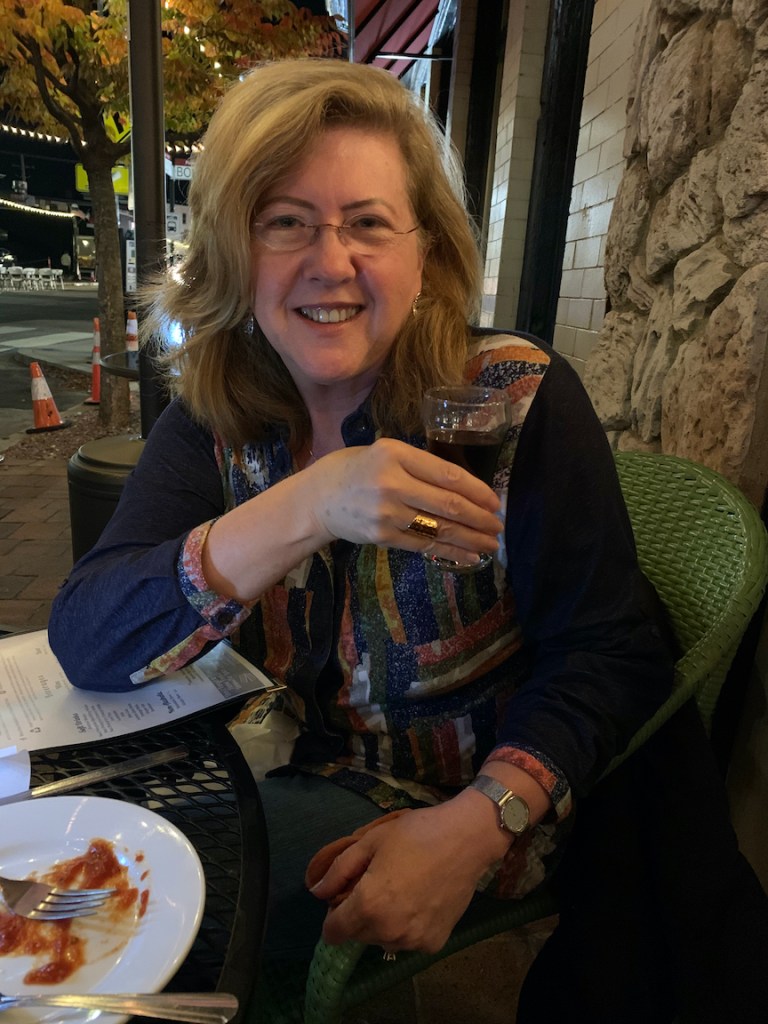
Jeffee Palmer was my intrepid guide during the first part of my stay in Providence. She had never been there before, but she had a guidebook, and she knew how to use it. We had great adventures. Here we are dining outside on Atwells on a weekend night when the street is closed to cars.
Martinis at Venda’s. Photo by Jeffee Palmer. The martinis are so big you can’t pick them up until you drink some out. They pack a wallop!
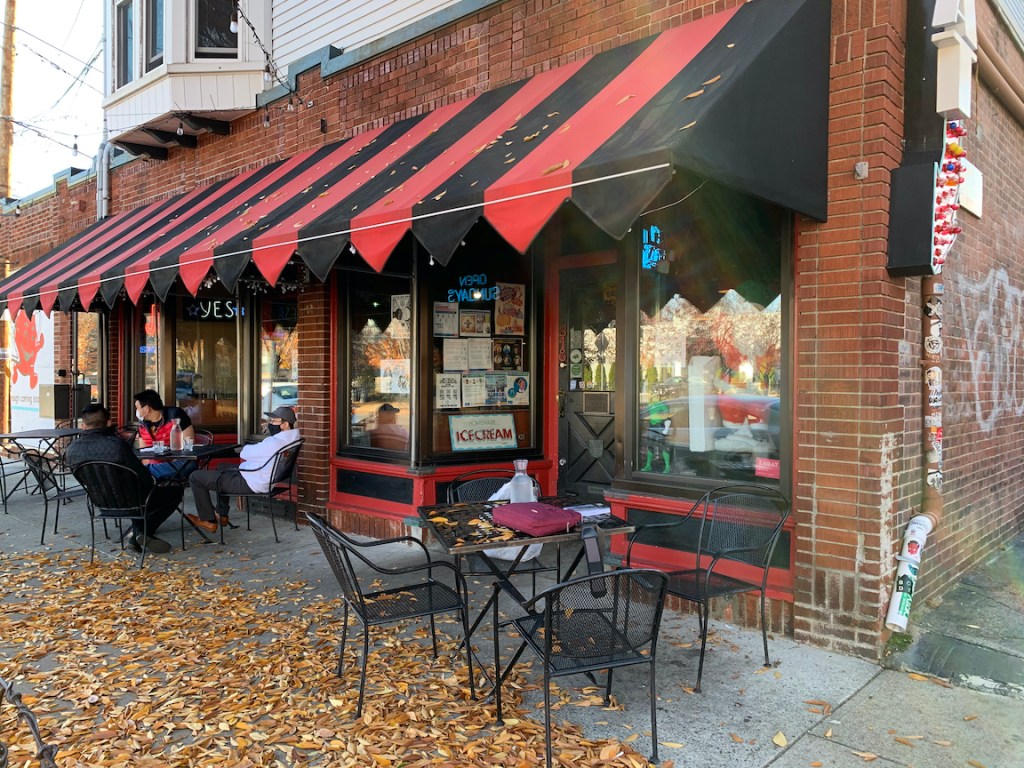
Julian’s is a comfortable restaurant on Broadway that runs from breakfast to late night, serving up good food, drinks, and friendliness.
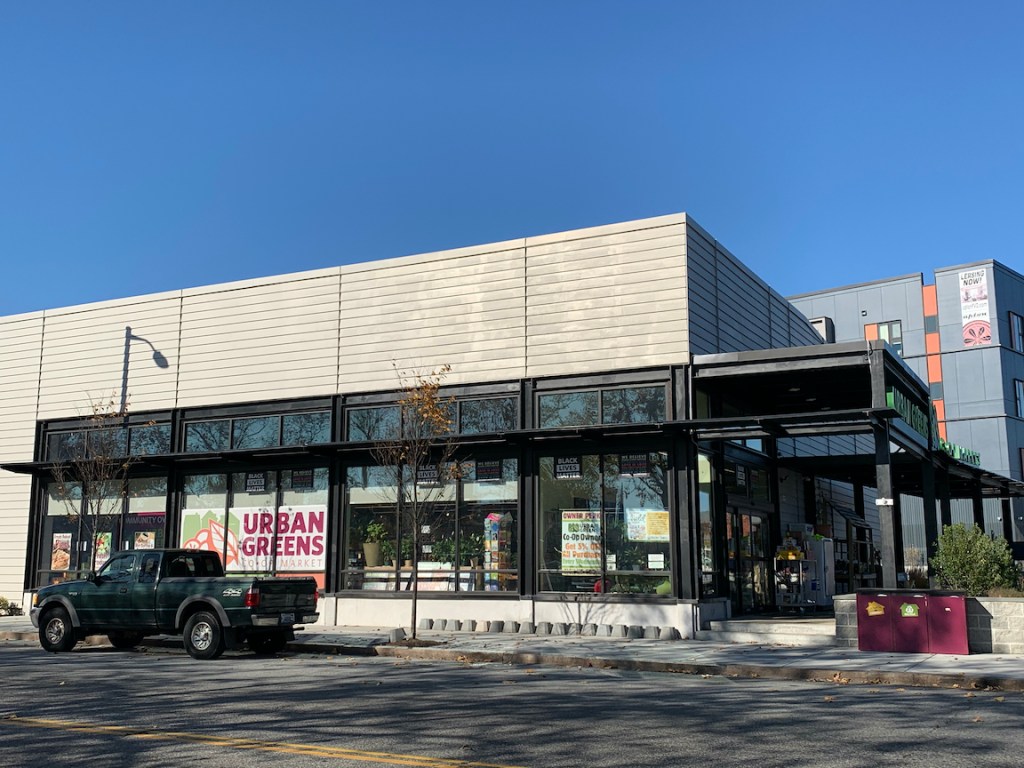
Urban Greens is the food coop in Providence, with a modern store but about the size of the early Wheatsville location on 29th Street.
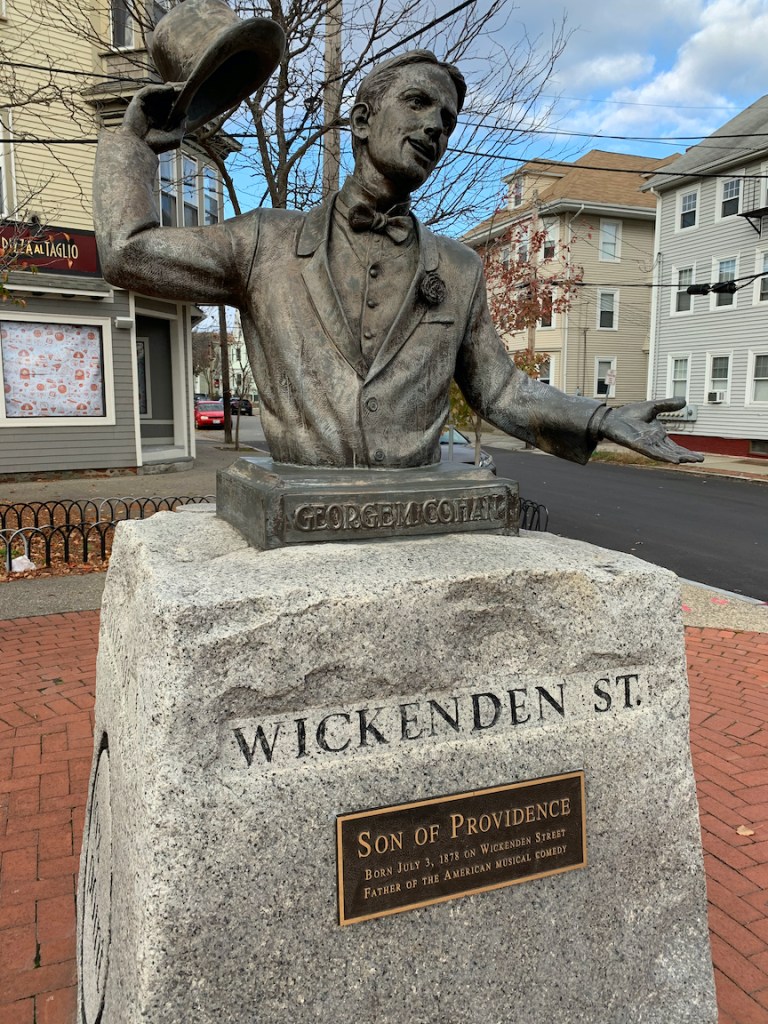
George M. Cohan was a native of Providence, and they’re proud of their yankee doodle dandy. His statue stands in the heart of Fox Point.
The Point Tavern takes its name from Fox Point, east and near the mouth of the Providence River.
Fox Point Hurricane Barrier was built to protect the city from hurricane storm surge. It looks pretty high, but then the Galveston Seawall looked high until the hurricanes started running over it. The bridge lies beyond it.
Trinity Brewhouse is one of several good pubs in downtown Providence. So many pubs, so little time!
Donald Trump, despicable demagogue, has been defeated. This is the victory of a lifetime for Joe Biden. But it’s a Pyrrhic victory for Democrats.
Trump is two steps down from Richard Nixon. William F. Buckley gave an apt defense of Nixon. When someone called Nixon a tenth-rate politician, Buckley retorted that Nixon may have been a tenth-rate man, but he was a first-rate politician. Trump is a tenth-rate man and a third-rate politician. His one talent is fulminating.
His talent for fulminating was enough to make him president of the United States, and that is a fearsome revelation of the state of the States. A substantial minority of citizens is ready to burn the country down. And they are waiting for a man with a torch.
Why? Who are they? They are poor, uneducated, and asocial. They live in the big empty spaces of our country, where they eke out a living and glare enviously at the wealth of city-dwellers. When I write that they are willing to burn the country down, I mean they are willing to burn the cities down. Trump’s fulminations are a cocktail for them.
Well, it’s not that simple. They live on a political spectrum of the right from fascists through reactionaries to conservatives.
Biden won by soothing the fears of the conservatives. That wasn’t the only way to win, but that’s the way he won. As the Democrats always do, Biden made the calculation that the left would support him because where else are they going to go? And as they always do, centrist Democrats are now busy demanding that the left shut up and not upset the right.
If the nihilism of the right is a harsh kind of insanity, the appeasement of the center is a soft kind. It’s the insanity of doing the same thing and expecting a different result. It’s Mike Dukakis thanking George Bush* for not using the “L” word.
The centrists achieved a tepid victory. Considering the mortal danger we are in, the Democrats made a pitiful showing. They won’t have the strength to do much. How is it that when the Republicans win power, they can do tremendous damage, but when the Democrats win, they can barely manage to do some deferred maintenance?
A more perfect union: step by step. Republicans worked for two generations to take control of the courts. Democrats can take control of the House and the presidency in just one generation. And we can rein in the Supreme Court.
First, expand the House. It hasn’t been done in four generations. Even setting aside the improved representation, this solves several problems. It reduces gerrymandering. It changes the balance of the electoral college. It changes the number of state delegations controlled by each party. It shifts representation toward the cities, where the people are.
Second, expand the Supreme Court. It hasn’t been done in six generations. Also, limit the jurisdiction of the Supreme Court. For example, take away the authority to invalidate acts of Congress. Also, rotate the membership on the Supreme Court among all the appellate judges.
The steps outlined above can be taken with simple acts of Congress. Of course, that requires that Democrats have full control of both the House and the Senate as well as the Presidency. What if we don’t win the two Georgia Senate seats? Below are two steps that might get through a divided Congress.
Third, develop the Dakotas. Three generations ago FDR flew over the South and saw its backwardness. He took the initiative to develop it. Now, three generations later, that investment is paying off. Developing the Dakotas would be the same investment, and because those states are basically empty, the investment required would be smaller and would pay off sooner.
Several developments can draw educated and diverse citizens to the Dakotas. First, establish a major city of at least half a million residents in each state. Make some land grants. Locate a substantial Federal government center there. Also, create an industrial center that would attract major employers like Amazon or Google or Apple. This would bring in educated residents who could have a major impact on the culture of the state. A large center for environmental stewardship of public lands could be a liberalizing influence. These moves would immediately pay dividends by providing employment and hope to the region.
Fourth, expand federalism. Renovate interstate compacts and floor pre-emption. Provide for a comprehensive system of interstate compacts that can handle issues on a regional level that don’t command a majority on the national level. With floor preemption, the federal government sets minimum standards, and the states, or the interstate compacts, set higher standards. This is already done in a hodgepodge fashion. Rationalize it.
Beware of nullification. Nullification is the theory that a state doesn’t have to follow an act of Congress that it believes is unconstitutional. It was favored by Jefferson until he was elected president. Then it was disgraced by John C. Calhoun, who used it to protect slavery. The right has used nullification to restrict abortion. The current very successful movement to legalize marijuana is basically an exercise of nullification. Regardless of federal law, the states are legalizing it. This is dynamite. Handle with care.
Finally, expand the Senate. This one requires an amendment to the Constitution. This is the long game. It can be incubated in the interstate compacts. Provide that every state will receive one senator for every two (or three) members of the House. Sure, keep the minimum of two senators per state. This will complete the democratization of our government.
Trump will leave fulminating against our democracy. It is up to us to choose whether we will simply stand pat on eroding ground or fix the foundation.
Democrat at the breakfast table.
The Helsinki Syndrome
I had to correct this, after I remembered that Dukakis did not run against Reagan. So, was it Mondale who said it to Reagan, or Dukakis who said it to Bush?





















 RobinCravey