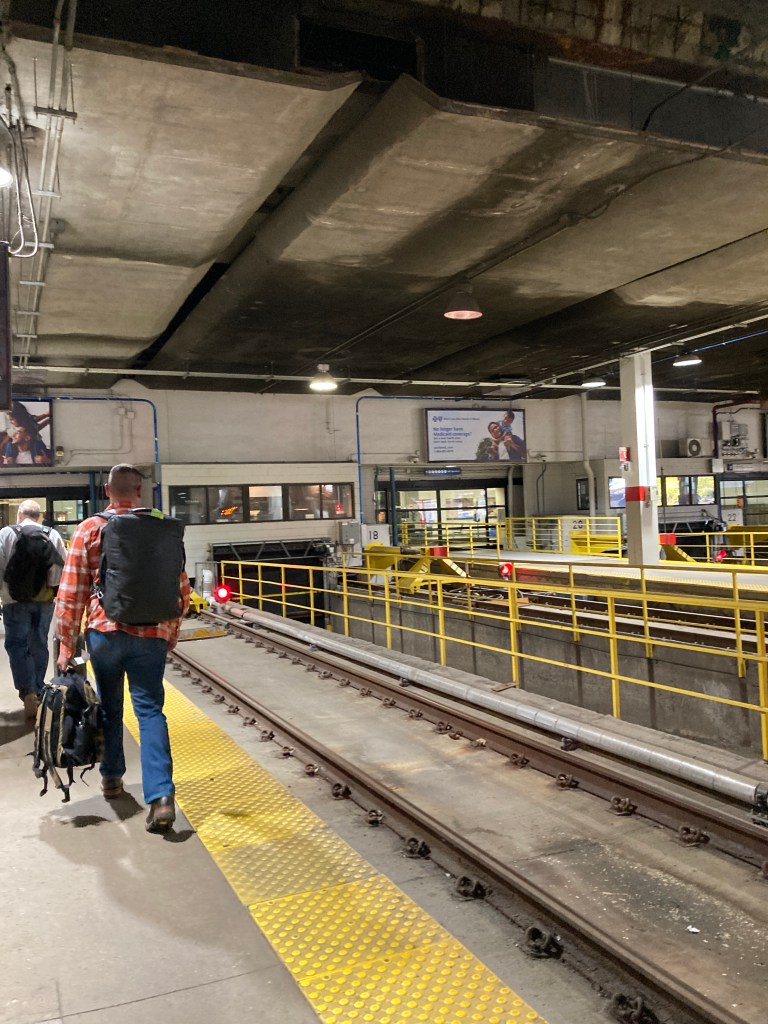
We enter the station through the railyard, which is dug under the station in a cavernous enclosure. All the surfaces are raw concrete and steel. They look dirty, except the platform.
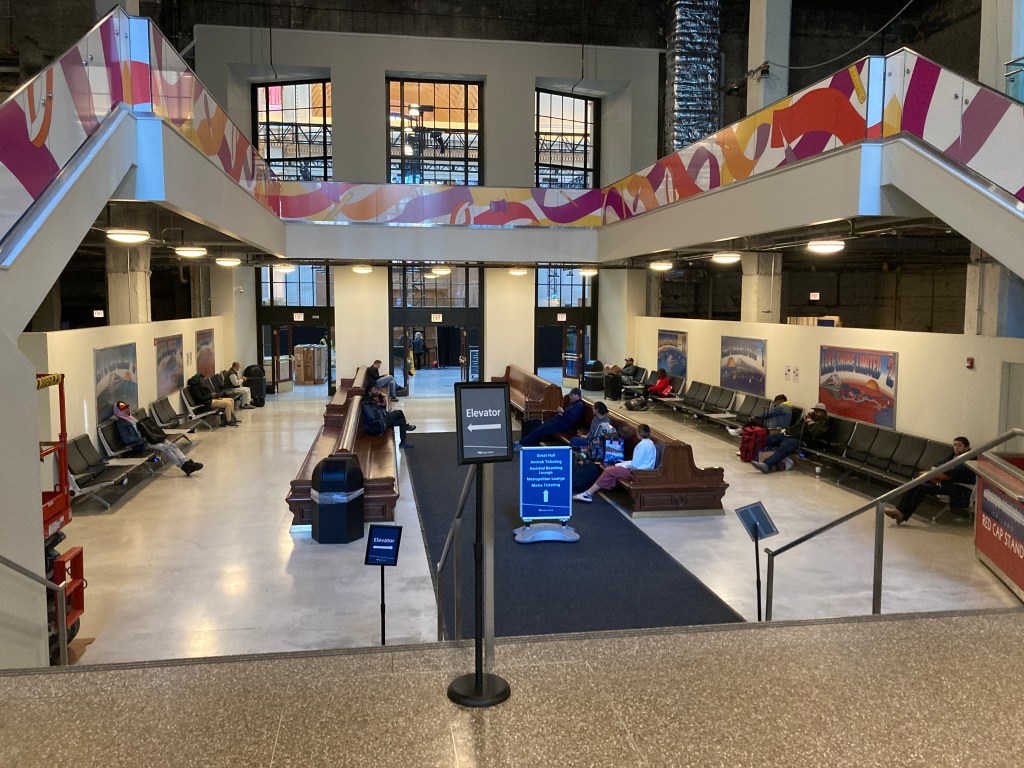
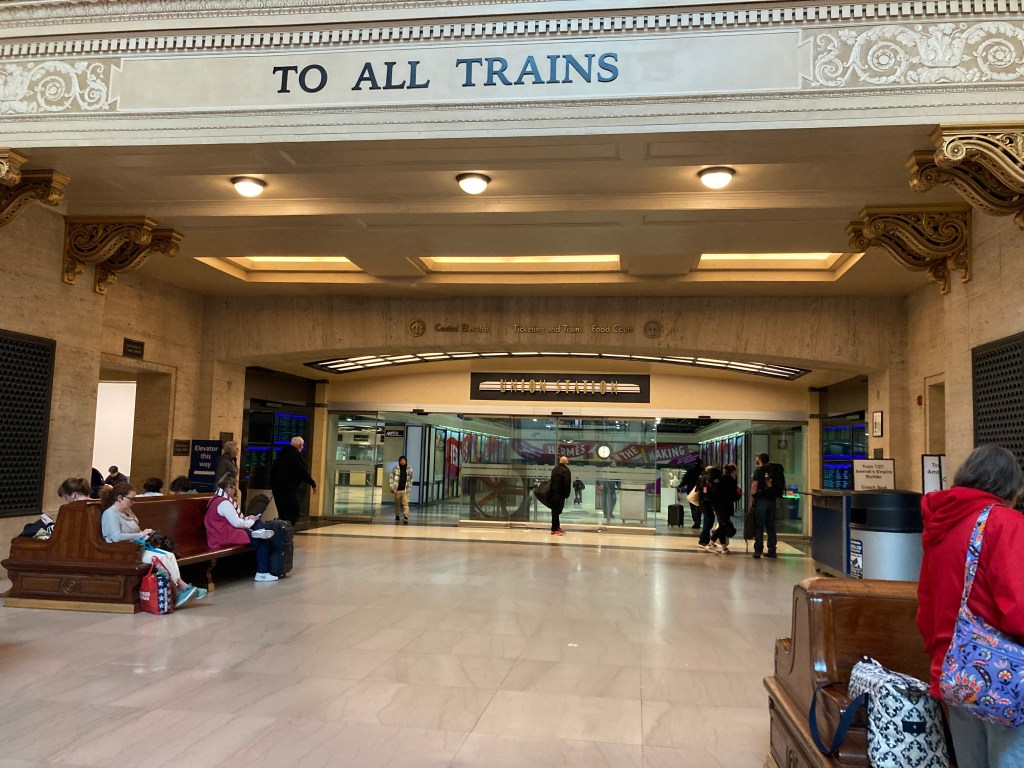
Above, the station is a grand old building that management is struggling to maintain. Lofty ceilings curve over a tile hall with comfortable wooden benches. Now I know my way to the Metropolitan Lounge.
I check into the Lounge at the reception desk. I turn right to leave a bag in the storage room. Then back around front and over to the lounge area.
The main room stretches back, and generous side rooms open on each side. An open staircase descends from above. Soft jazz plays.
A refreshment counter offers free snacks and drinks. A cash bar is tucked under the stairs.
People sit at tables, sit on couches, lie on couches. This a place for relaxing.
I have about six hours to spare.
The underground railyard at Chicago Union Station greets passengers with raw concrete and steel.Metropolitan Lounge is a refuge for first class passengers.View from the street entrance looks to a concourse at the train station.Arched windows over a concourse to the rail platforms.Conourse leading to the railyard is broad with a classic look.Passengers all down the underground platform toward the train station.
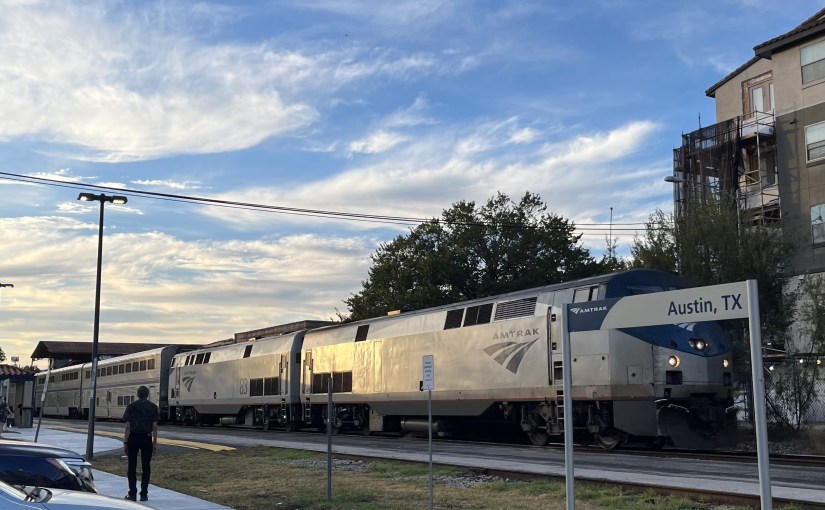
Austin station is an insult to train riders. This is what you get from a city that gives endless lip service to public transit, but does very little about it. It’s on the edge of downtown, but it’s hidden away up a hard-to find dead-end street behind the YMCA. The station itself is underwhelming, with a small inside waiting room and not even the most basic food services.
As we roll north, the conductor announces the stops. Most are quick. At some, through-passengers are allowed to get off, stretch their legs, and breathe fresh air or have a smoke. The conductor offers a wry caution, “When all aboard is called, enter the train. If you are not on the train when the train leaves the station, you will be left. That’s all right, you can catch the next train tomorrow.”
At Dallas Union Station, I get off to stretch my legs. The trainside walkways are pretty nice, red brick edged by that yellow bumpy caution strip. Little canopies are spaced down the middle. There are several sets of double tracks. If I walk down a way, I can get a look at the station building, brick painted while. A walkway crosses all the tracks and leads to the station, but I don’t want to leave trainside.
At St. Louis Union Station I get off again. The trainside platform is bare concrete with the yellow edge, but it’s clean. The tracks are out in the open air, under the sky. A hulking skyway rises from the platform and crosses other tracks, crosses car traffic, ducks under a raised highway, and disappears.
Dallas Union Station beside the tracks.
Boarding platform at Dallas Union StationPedestrian bridge to St Louis Union Station
In the morning, about 5:30, I head down to the diner. Walt has an urn of coffee made at a little station by the stairs, and I draw some into a paper cup as I pass. The kitchen won’t be open until 6:30.
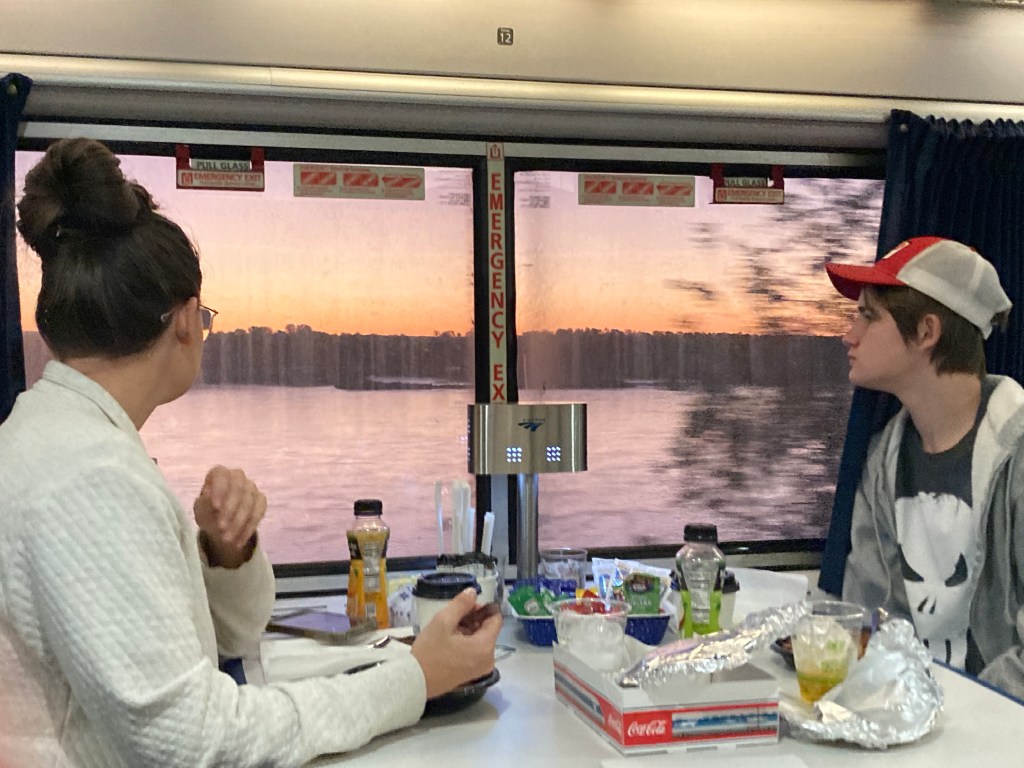
In the diner, I sit down at a table to read the news. Out the windows to the east, the sun is rising over the Mississippi. The sky glows a soft orange.
Breakfast comes. I have an omelet, home fries, and sausage links. Not bad.
Todd and I talk about the state of the railroad and the way it got this way. For the first time in decades, there is hope. Amtrak Joe pumped a tank of billions into the system. A lot of deferred maintenance will be done, but more difficult is the restoration of a train industry in the U.S. after decades of underfunding.
Lately, during the pandemic, Amtrak cut operations way back. Then their parts suppliers went out of business. So now there are no parts to repair the trains. That’s no way to run a railroad.
After breakfast I retire for a respite in the room. I make some notes. I nap a little. I read a little. Soon I pick up the macbook and head for the diner.
In the diner, I find the table with my room number on a slip of paper and sit down. I have at least an hour until lunch. I open the macbook and start drafting.
Lunch was forgettable.
Amtrak took all the full-service diners off the trains during the pandemic. After the pandemic, Amtrak did not have enough cars to restore full dining to all trains. The Texas Eagle was one of the losers.
One thing, the food is plentiful. You won’t lose weight eating in first class.
Soon after I’m done, I have to vacate the table for the next hungry seating.
Back in my room from lunch, I read a little. Then I turn myself to organizing and packing for the train change.
I listen to crew members chat as they pack up their rooms. We’re near the end of the trip. Everyone on the crew is thinking of the chores they must do to shut down the train. Their paid time stops when the train stops. If they’re not finished with their chores, they will finish on their own time.
Goodbye again.
Sunrise over the water, looking out the diner window.Bags are lined on the the luggage shelves.
After supper, I head back to my room. Actually, it’s a roomette—a little room about 3 x 7 with the corridor on one side and the windows on the other. Two little bench seats face each other. There’s a tiny pullout table, but I don’t pull it out, much. The seats pull out to a recliner, and I do pull those out.
The upholstery and wall coverings are dark royal blue, which makes the room dark, and the lights are barely adequate. I lean back, with a pillow under the small of my back, reading a novel.
Walt, the sleeper man, comes by to ask me when I want my bed turned down. The two seats make into a lower bunk, and an upper bunk pulls down from the ceiling. I’m alone, so I only need the lower bunk made up. I ask him to put out some towels, so I can take a shower, and he says he will.
The roomettes share a shower downstairs. The full rooms have showers and toilets in suite. I can’t afford a full room. I’d like to, but no can do.
I don’t spend a lot of time in the roomette. It’s cozy, but close. One interesting feature: the room doors cannot be locked or even latched from the outside. And frequently, as the train speeds up and slows down, the doors slide open. It’s not unusual to come back to your room and find the door open. Don’t worry, it’s just the rocking of the rails.
The train generally runs between pretty smooth to a little shaky, but sometimes it veers into wobbly or even jerky. When it’s jerky, that interdimensional space between the cars can raise your hackles, as the car behind you lurches left while the car before you lurches right.
I decide to take a quick shower and change into my jammies. The shower room is a small cubicle, with another cubicle for undressing and dressing. Walls are drab gray vinyl. The shower head is on a wand, the water pressure is good, and the water is plenty hot.
I get back to my room in time for Walt to come by and make my bunk. I settle in with a book. The overhead light is really poor, and the reading light casts a glare. I brought a lantern, but it’s in my rolling bag downstairs. To hell with it.
I punch off the lights and close my eyes. First, I punch the call button for the attendant. I don’t want the attendant, but the call button is next to the light switch, so I punch it by mistake. I punched the call button by mistake in the toilet and the shower, too. I felt like a nuisance, but the attendant never came, so I stopped worrying about it.
Soon I notice that the car is repeatedly jerking and bucking, tossing me back and forth in the bed. This doesn’t help my insomnia. We’ve run into some bad track. And we keep running on bad track most of the night. I sleep in short dozes. Finally, about 5:30, I get up and get dressed.
Walt will make up your bed at night and restore your room to a little parlor in the morning.The roomette is a little sitting room by day and a bedroom by night.The shower room is a small cubicle, with another cubicle for undressing and dressing.
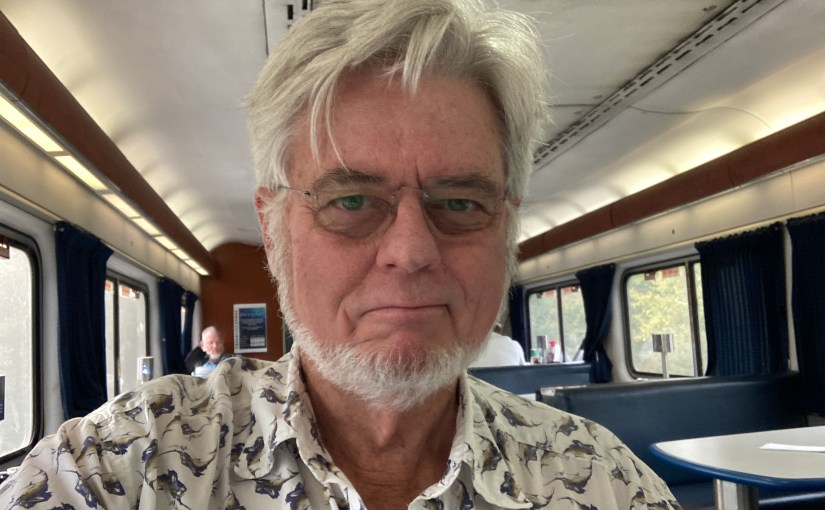
I’m sitting in the diner on board the Texas Eagle. We pulled out of Austin about 9:30 this morning (Saturday). I’ll be rolling into Providence, Rhode Island about 9:00 pm Monday night. It’s a relaxing way to travel, but it takes a while.
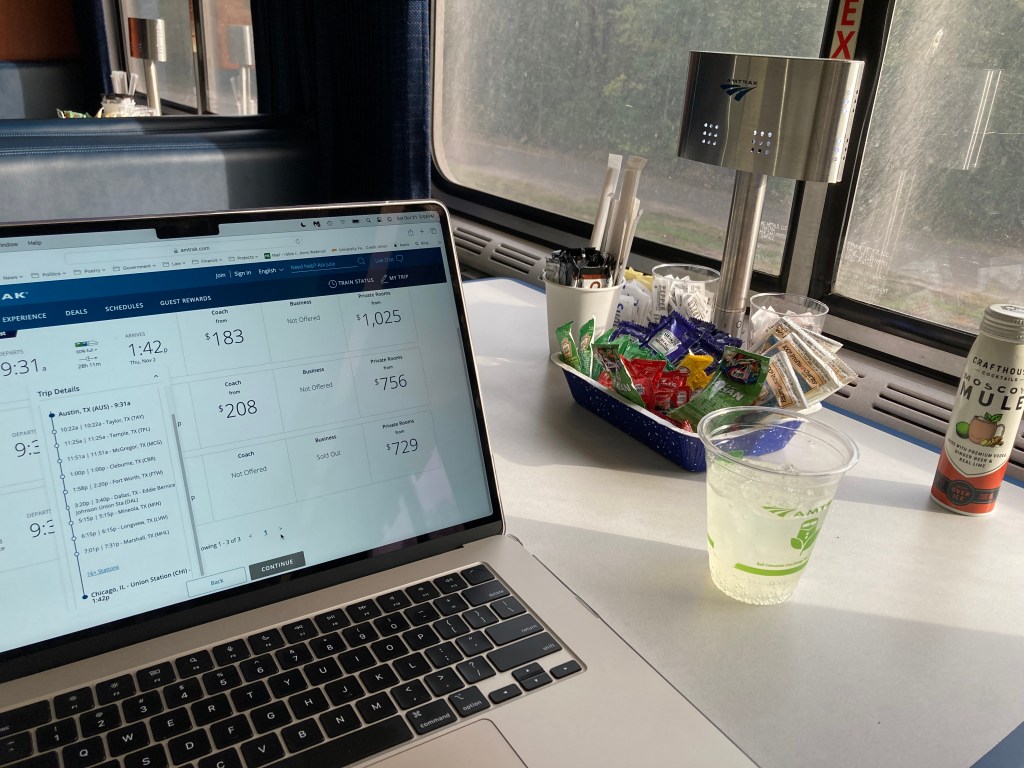
Outside my grand picture window, miles and miles of Texas are rolling past. This grand view is one of the things I love about train travel. A cup of whiskey sits on the table beside my macbook as I type. This is livin’.
I’m in the forward dining room, where ten booth tables line the center aisle. Behind me is the kitchen, and behind the kitchen is the café. The diner serves the sleeper (first class), and meals are complimentary. An adult beverage is included with dinner. The café serves the coaches.
After a while I go back to the counter in the café and order another drink. Christie, the café gal, serves it with good cheer. She’s busy.
I spend a lot of time in the diner. There’s always a table or two or three of crew members hanging out nearest the kitchen, jawboning about this train, other trains, this crew, other crews, management, and life in general. I learn a lot just eavesdropping.
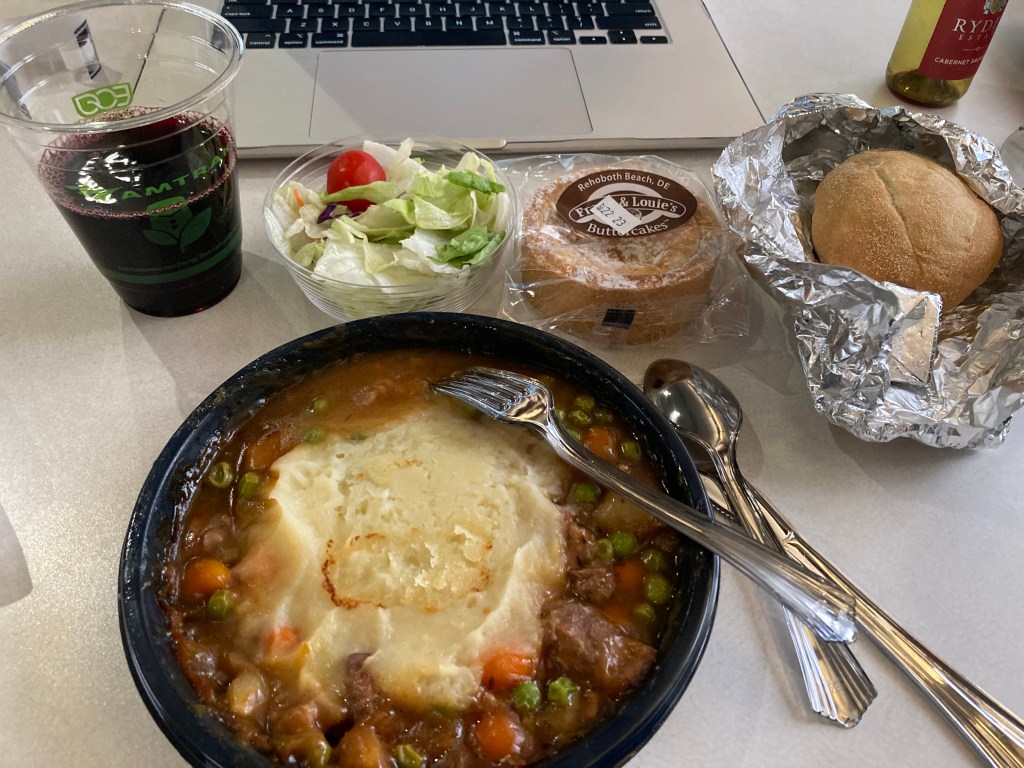
I’m waiting for supper now. Todd, the diner man, came by my room while ago and took my order. I ordered the beef Burgundy, vegetables, and mashed potatoes with a glass of red wine. I’ve had it before. It’s pretty good.
Dining is one step below fast casual. The food is all packaged and heated in an oven, served on plastic covered with foil. But it’s decent—pretty tasty.
Beef burgundy, vegetables, and mashed potatoes. With red wineTodd the diner man stands outside the train at a station stop in Dallas.Sitting in the diner, watching the world go by, drinking a Moscow mule and checking out train schedules on the MacBook.Christie serves it with a smile, from Chicago to Texas and beyond.
The Texas Eagle is a short train, one engine and four cars. Behind the engine comes the sleeper car, then the diner, then two coach cars. It runs from San Antonio to Chicago, one train each way, daily. The train usually runs full.
It runs full, because there is not enough rolling stock to serve demand. They can’t put another car on, because they don’t have one.
Major stops are in Fort Worth, Dallas, and St. Louis, with about two dozen others. The train runs slow because the tracks are not very good. Cell service is strong along the whole route.
Now and then throughout the day, the train pulls onto a sidetrack to let a freight train slowly pass.
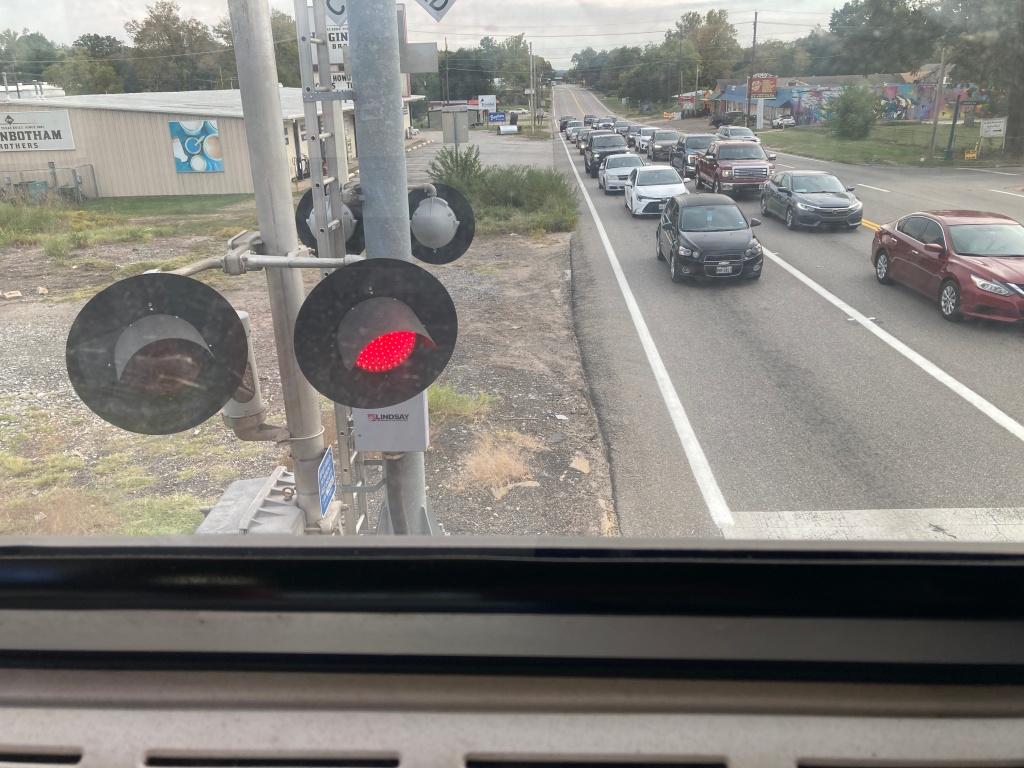
At one point, I look out and see that we are stopped across a street, and cars are stopped, waiting for us to pass. At first, I’m sorry, but then I remember how much cars have done to ruin transportation (and the environment) in America (and the world). Let them wait.










 RobinCravey