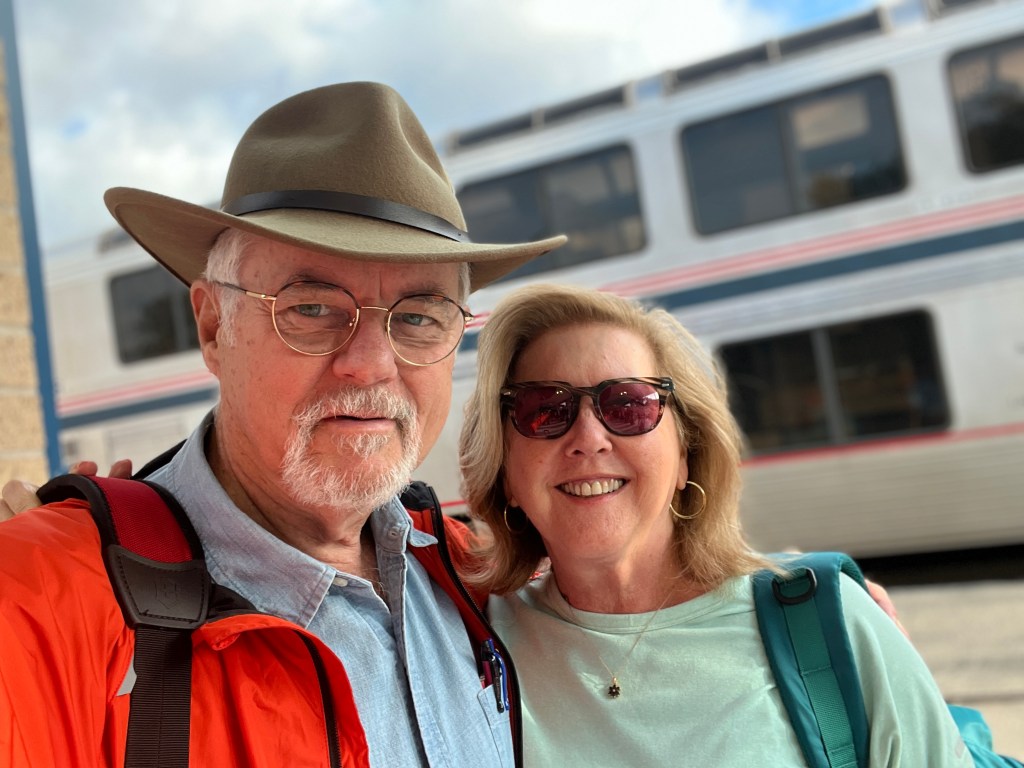
A couple of days after my wedding, my bride and I boarded the Texas Eagle to Chicago for our honeymoon. Every ride on the Texas Eagle is a different experience. The rolling stock changes, the crew changes, the service changes, and the season changes; all combine to make a trip comfortable, entertaining, friendly, or annoying. My recent ride has showed a real decline in service.
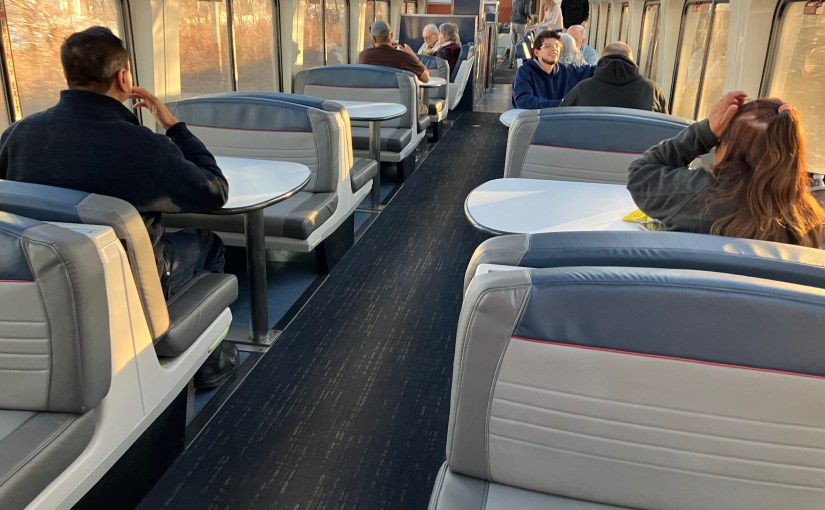
The Texas Eagle is a short train, with two or three sleeper cars up front behind the engine, and three or four coach cars down back, divided by a dining car in the middle. The sleeper cars are first class, with a hall down the length of the car lined by doors to private cabins. The coaches contain row after row of recliner seats, two on each side of the aisle, and big windows to the outside. On some trains, the order is reversed, with the coaches in front and the sleepers in back.
The cars are two-level, meaning you have to climb a spiral of stairs to get from the outside door to the main level. Below with the entry door are luggage racks, bathrooms, showers, and special accommodations. Above are the rooms in the sleeper cars or the reclining seats in the coach cars.
Dining/Café Car
The dining car, or café car, is the meeting place and the divider between sleeper and coach passengers. The dining/café car serves double duty as a fast-food café for the coach passengers and a full meal diner for the sleeper passengers. The dining room on the sleeper side, usually the front side, serves three sit-down meals daily to first class passengers. The café on the back side of the car serves fast food over the counter to coach passengers for ten or twelve hours a day. It’s a high-traffic café with a small dining room.
The dining/café car also served as the crew break room, and the crew would stake a few tables in one area or the other. This could be a chance for friendly mingling with the passengers, but sometimes there could be uneasy friction.
Lounge Car
One improvement in the train came last year, when the lounge car was added. The lounge car was pulled off for a while and loaned to the Illinois Central, so coach passengers had nowhere to go but their seats, and sleeper passengers had nowhere to go but their rooms. Still better than flying, but confining. They could go to the dining car, but on some trips the crew didn’t allow passengers to use the tables except at meal times.
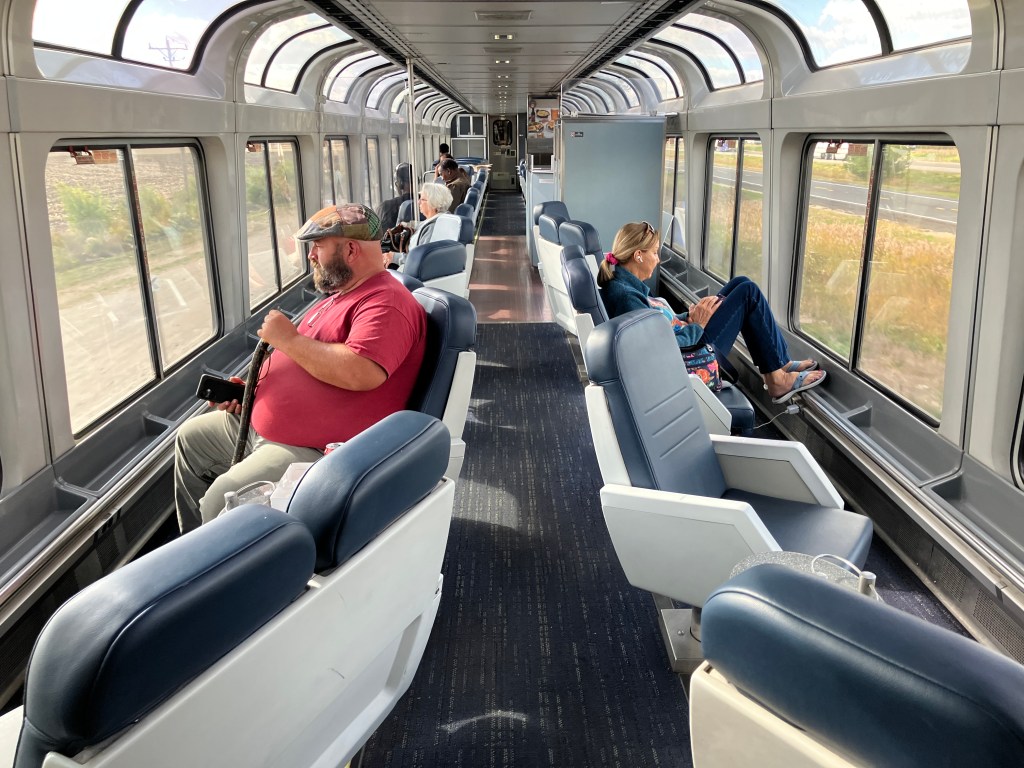
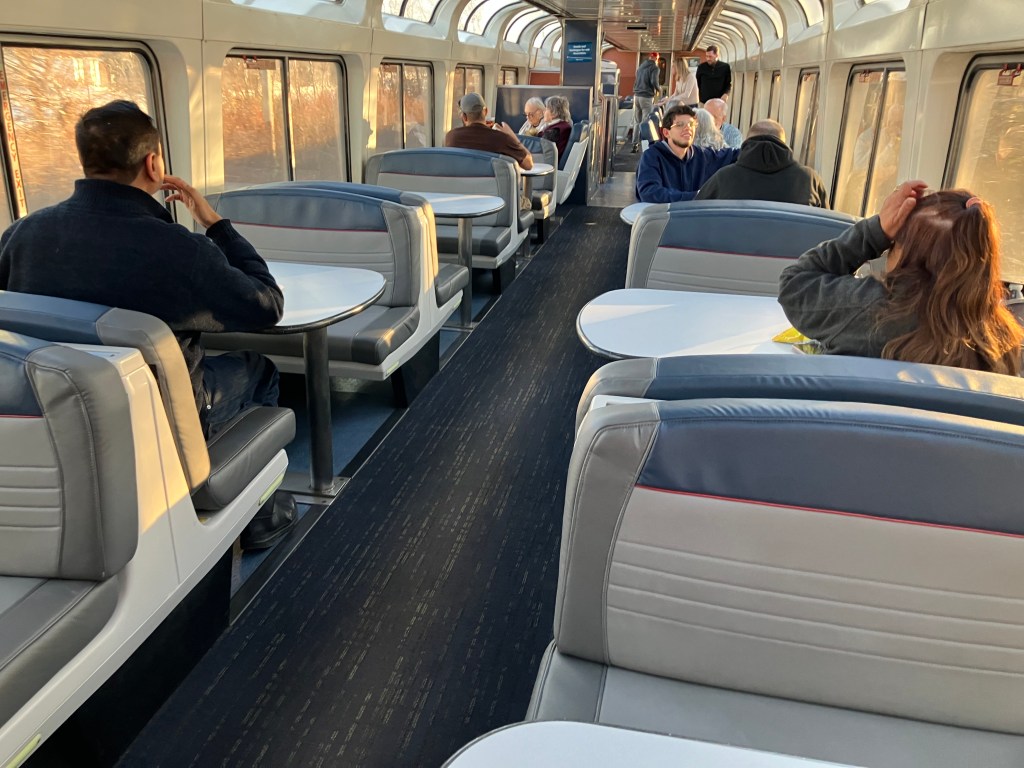
The addition of the lounge car changed everything. Most important, it provided a common living room where all passengers could go to relax. The huge seat-to-ceiling windows give a panoramic view of the passing landscape. The spacious floor plan, with seats facing the windows and a few booths with tables give ample space for sitting and reading, listening to headphones, entertaining kids, working on a computer, snacking, or just chatting with friends or strangers.
Also important, the lounge car has a café downstairs. It’s open from six or seven until ten, with breaks during the day. Now it serves as the café for the coach passengers. Sleeper passengers can drop in, too, for a cocktail or a snack when the diner is closed. There are a few booths for diners in the café, and there are tables upstairs in the lounge where diners can take their meals or drinks at leisure.
Dining Car
With the restoration of the Lounge Car, the Dining Car has become a much less busy place. The café is closed. The small dining room behind the galley, where coach passengers ate hurried meals, has become the crew lounge, where crew members have a little privacy for relaxing and chatting among themselves. Passengers passing through can stop to chat with the crew.
The large dining room in front of the galley has become the domain of the sleeper passengers.
Curiously, these innovations have brought a severe reduction in meal services for the sleeper passengers. Previously, sleeper passengers were served three sit-down meals per day. The chef always had at least one helper to put the food on the table. Depending on the chef, table service could be just adequate or approaching elegant. Now the chef has no helper, and two meals a day are bagged and handed out over the counter for the passengers to carry to their tables. There is still table service at supper, and it is just barely adequate.
I’ve seen this service before, on the Crescent. https://robincravey.com/2024/09/16/on-board-the-crescent/. Now, I’m told that management has ordered this second-class service on these two trains.
Sleeper
On long-distance trips, I always take a sleeper for the night. Generally, I’m in a roomette, which is a tiny cabin with two facing seats during the day and two bunks at night. On this trip, I have my bride, and we’re taking a room.
The room is tight but comfortable. A couch along the back wall faces forward to the sink next the door and the small conversation space next the windows. In the conversation space a jump seat sits next the window. Opposite, a door opens on the combination toilet and shower.
Unfortunately, this is one of the inferior cars. The ceiling is low, not far overhead, with no upper shelves for storage, and a cramped upper bunk.
The couch pulls out into a bed, but it’s cranky. The porter makes it work. When bedtime comes, there is barely enough room for my bride and me. I could go to the upper bunk, but I think not.
Onward
Since Amtrak Joe pumped a slug of money into the system, improvements have been lurching forward very slowly. This train shows it. The crews show it. A few years ago the crews on this train seemed optimistic, imbued with a team spirit. Now they seem disappointed, embarrassed, cynical. For their sakes as much as for the traveling public, I hope management does their duty and gets on with the improvements.
 RobinCravey