Texas Eagle:  Something new, something old

A couple of days after my wedding, my bride and I boarded the Texas Eagle to Chicago for our honeymoon.  Every ride on the Texas Eagle is a different experience.  The rolling stock changes, the crew changes, the service changes, and the season changes; all combine to make a trip comfortable, entertaining, friendly, or annoying.  My recent ride has showed a real decline in service.

The Texas Eagle is a short train, with two or three sleeper cars up front behind the engine, and three or four coach cars down back, divided by a dining car in the middle.  The sleeper cars are first class, with a hall down the length of the car lined by doors to private cabins.  The coaches contain row after row of recliner seats, two on each side of the aisle, and big windows to the outside.  On some trains, the order is reversed, with the coaches in front and the sleepers in back.

The cars are two-level, meaning you have to climb a spiral of stairs to get from the outside door to the main level.  Below with the entry door are luggage racks, bathrooms, showers, and special accommodations.  Above are the rooms in the sleeper cars or the reclining seats in the coach cars.

Dining/Café Car

The dining car, or café car, is the meeting place and the divider between sleeper and coach passengers.   The dining/café car serves double duty as a fast-food café for the coach passengers and a full meal diner for the sleeper passengers.  The dining room on the sleeper side, usually the front side, serves three sit-down meals daily to first class passengers.  The café on the back side of the car serves fast food over the counter to coach passengers for ten or twelve hours a day.  It’s a high-traffic café with a small dining room.

The dining/café car also served as the crew break room, and the crew would stake a few tables in one area or the other.  This could be a chance for friendly mingling with the passengers, but sometimes there could be uneasy friction.

Lounge Car

One improvement in the train came last year, when the lounge car was added.  The lounge car was pulled off for a while and loaned to the Illinois Central, so coach passengers had nowhere to go but their seats, and sleeper passengers had nowhere to go but their rooms.  Still better than flying, but confining.  They could go to the dining car, but on some trips the crew didn’t allow passengers to use the tables except at meal times.

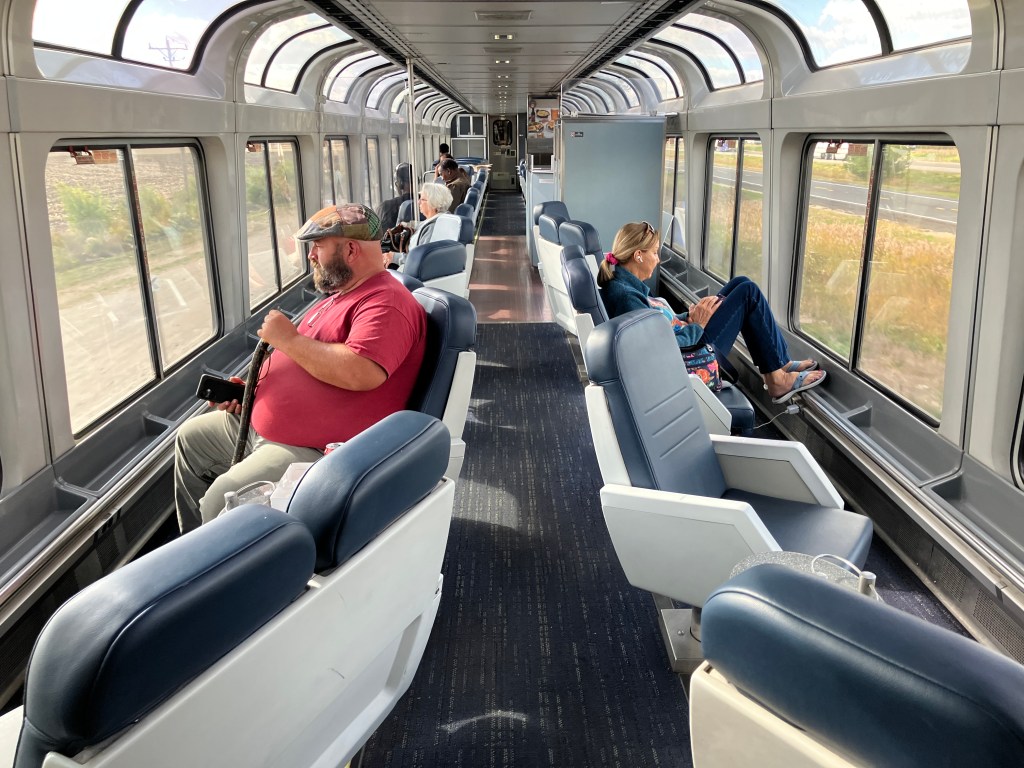
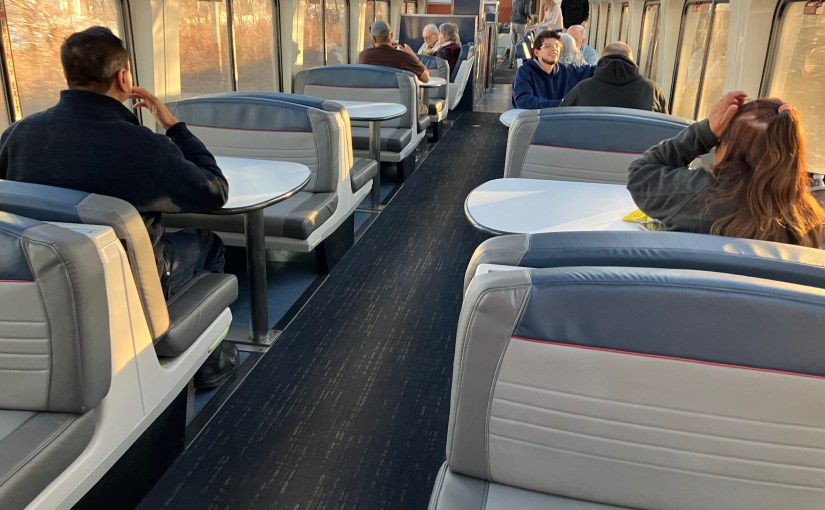
The addition of the lounge car changed everything.  Most important, it provided a common living room where all passengers could go to relax.  The huge seat-to-ceiling windows give a panoramic view of the passing landscape.  The spacious floor plan, with seats facing the windows and a few booths with tables give ample space for sitting and reading, listening to headphones, entertaining kids, working on a computer, snacking, or just chatting with friends or strangers.

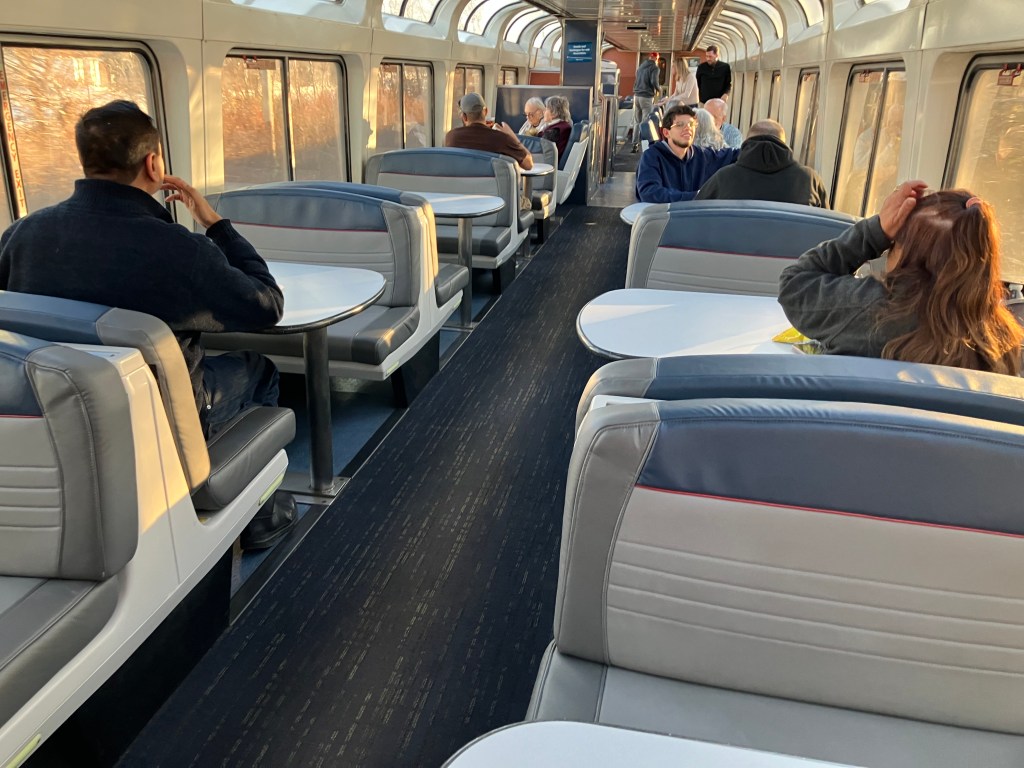
Also important, the lounge car has a café downstairs.  It’s open from six or seven until ten, with breaks during the day.  Now it serves as the café for the coach passengers.  Sleeper passengers can drop in, too, for a cocktail or a snack when the diner is closed.  There are a few booths for diners in the café, and there are tables upstairs in the lounge where diners can take their meals or drinks at leisure.

Dining Car

With the restoration of the Lounge Car, the Dining Car has become a much less busy place.  The café is closed.  The small dining room behind the galley, where coach passengers ate hurried meals, has become the crew lounge, where crew members have a little privacy for relaxing and chatting among themselves.  Passengers passing through can stop to chat with the crew.  

The large dining room in front of the galley has become the domain of the sleeper passengers.

Curiously, these innovations have brought a severe reduction in meal services for the sleeper passengers.  Previously, sleeper passengers were served three sit-down meals per day.  The chef always had at least one helper to put the food on the table.  Depending on the chef, table service could be just adequate or approaching elegant.  Now the chef has no helper, and two meals a day are bagged and handed out over the counter for the passengers to carry to their tables.  There is still table service at supper, and it is just barely adequate.

I’ve seen this service before, on the Crescent.  https://robincravey.com/2024/09/16/on-board-the-crescent/.  Now, I’m told that management has ordered this second-class service on these two trains.

Sleeper

On long-distance trips, I always take a sleeper for the night.  Generally, I’m in a roomette, which is a tiny cabin with two facing seats during the day and two bunks at night.  On this trip, I have my bride, and we’re taking a room.

The room is tight but comfortable.  A couch along the back wall faces forward to the sink next the door and the small conversation space next the windows.  In the conversation space a jump seat sits next the window.  Opposite, a door opens on the combination toilet and shower.  

Unfortunately, this is one of the inferior cars.  The ceiling is low, not far overhead, with no upper shelves for storage, and a cramped upper bunk.

The couch pulls out into a bed, but it’s cranky.  The porter makes it work.  When bedtime comes, there is barely enough room for my bride and me.  I could go to the upper bunk, but I think not.

Onward

Since Amtrak Joe pumped a slug of money into the system, improvements have been lurching forward very slowly.  This train shows it.  The crews show it.  A few years ago the crews on this train seemed optimistic, imbued with a team spirit.  Now they seem disappointed, embarrassed, cynical.  For their sakes as much as for the traveling public, I hope management does their duty and gets on with the improvements.
Neptune Hotel, Providence

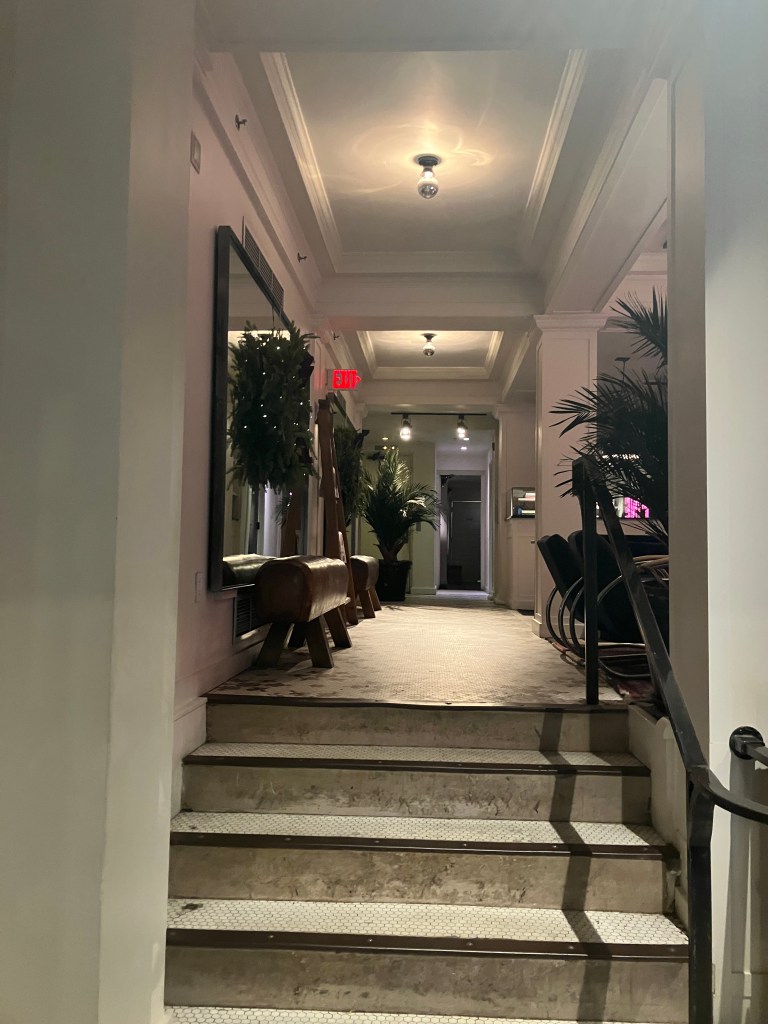
It’s a funky old downtown hotel, several steps up from the sidewalk.  The esthetic seems to be artsy threadbare.  Several good bars are just around the corner.  The train station is about a mile away.

A friendly clerk handles check in at the desk and explains that there is hotel bar, but only open on certain nights, and a coffee shop only open in the mornings.  She finds the bellman, who then carries my bags up with cheerful solicitude.  The main hotel is another half dozen steps up.  

The lobby is small, with black couches and bad lighting.  Neon signs decorate here and there, and a generous expanse of mirrors improves the sense of space.  The floors are tile or planking with occasional rugs.

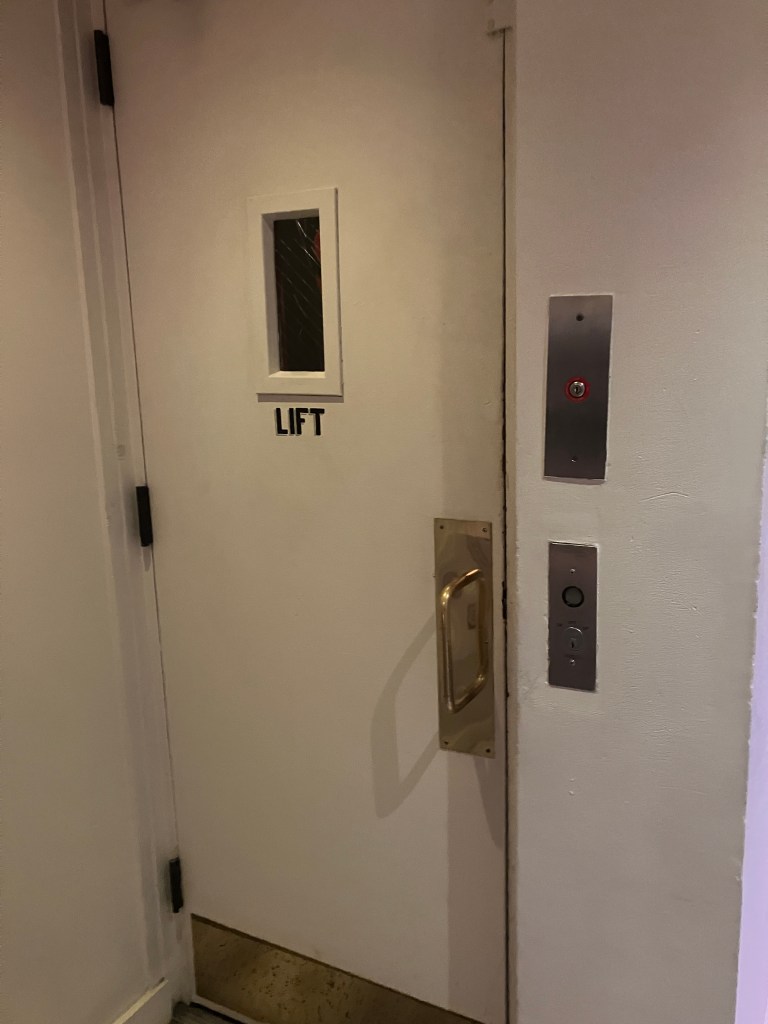
From the main floor, you go up in a “Lift” that has a door on hinges that opens on a steel cage.  The cage travels slowly up and down in a concrete shaft that you could reach out and touch as it slides past, if you were so foolish.  The concrete is raw between floors, with a painted red door at each floor.  I’m told the hotel was once a brothel.

The lights are garish, I can say that.  None meant for reading.  All dim and glaring at the same time.  The halls are shadowy.

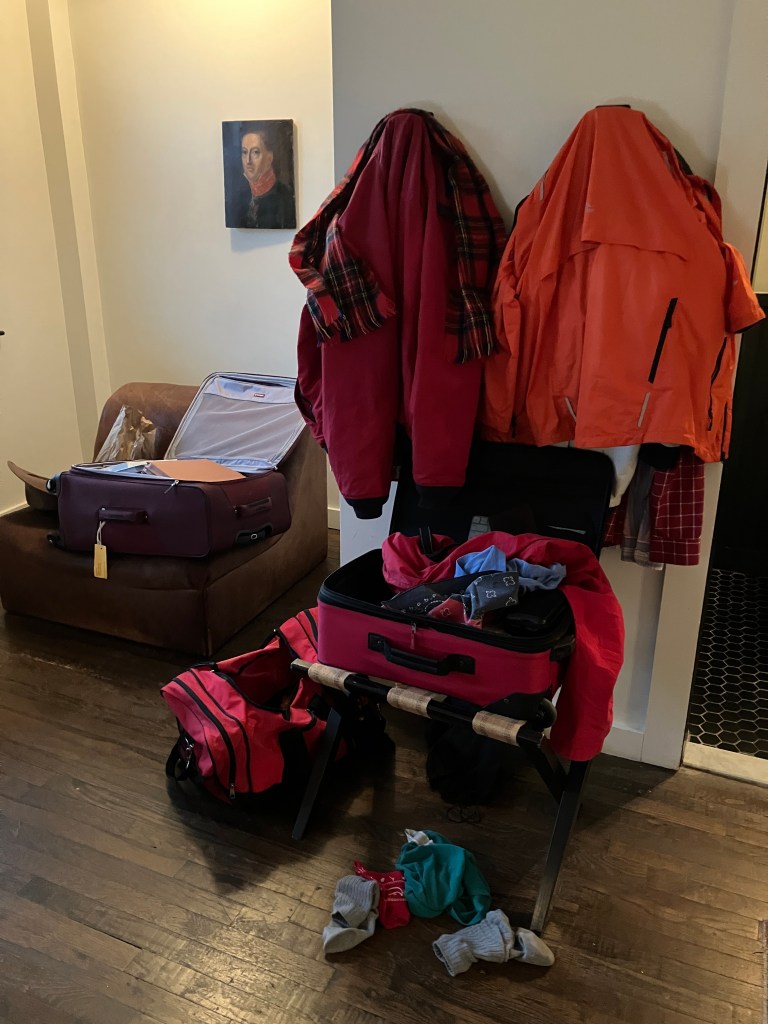
The room is dark with spots of illumination at key points.  When the sun comes in the western windows, the light is good.  There is a vintage half-couch that molds you into a laid-back posture almost like a hammock.  Hm.  The bathroom is black tile, gloomy, and there is no hot water.  

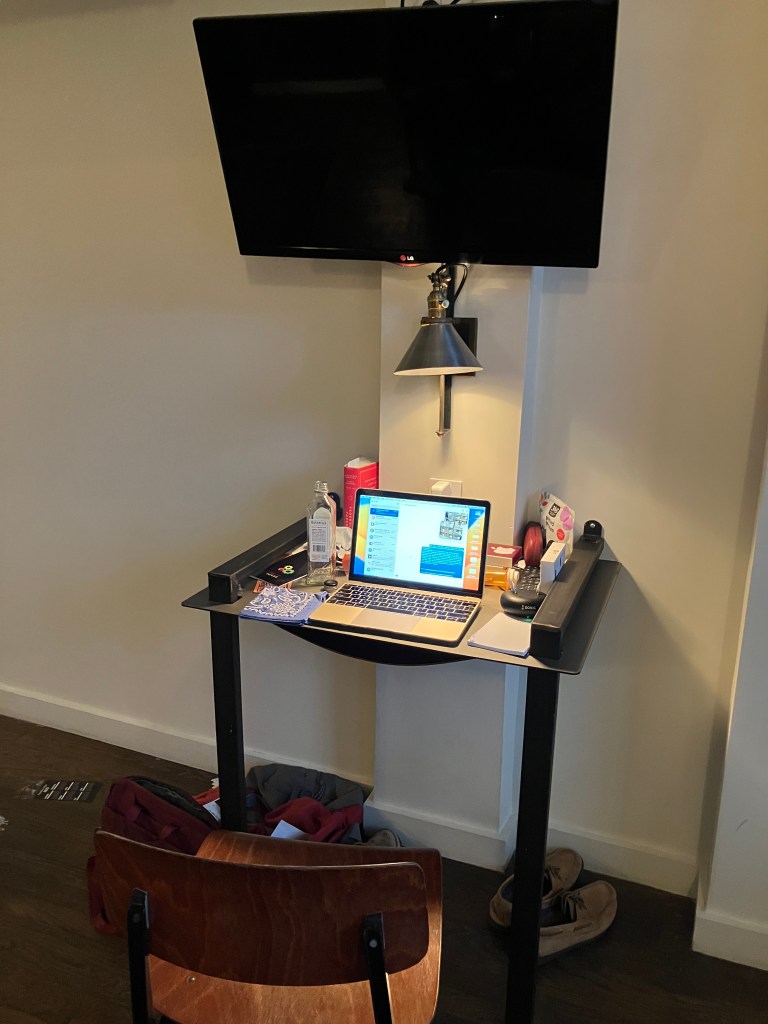
The television is easy to operate, unlike in most hotels.  A tiny desk allows work at a laptop.  There are plenty of electrical outlets.

The bed is big and comfortable, with adequate covers and good pillows.  I slept well and made it to the train station by 5 am.

Sunset Valley to Lake LadyBird

Mostly sunny sky.  Heat forecast.

Stopped at La Madeleine for some orange juice.  Sat at the table and studied the map.  I wanted to cycle from Madeleine to the river without going down a major street—Lamar, Menchaca, S. 1st, S. Congress.

Found two.  I chose one:

Jones Road to Packsaddle Pass.

At Packsaddle Pass, turn left and then to Redd.

At Redd, turn right and to Banister.

At Banister, turn left, after several blocks 

Dogleg right and to Garden Villa.

At Cardinal, turn left and to S. 5th.

At S. 5th, turn left.  Home free.

It would be helpful if Cumberland would connect with Bridgeway.

I had to cross a few major streets, but I never had to ride on one.  All easy neighborhood streets.  On S. 5th, new apartment complexes joined old ones and crowded out more houses.

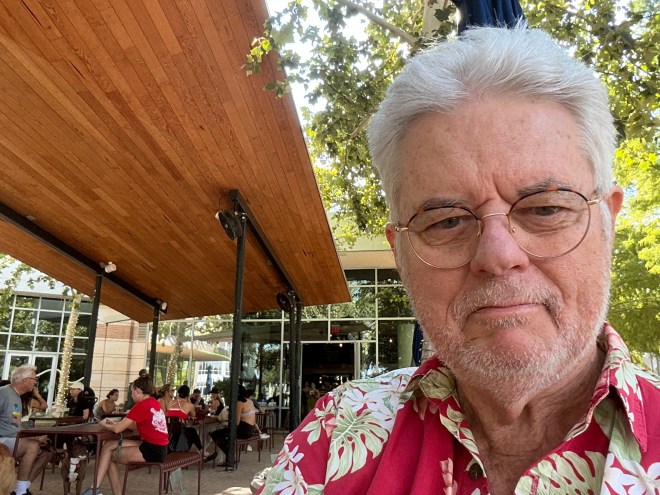
I crossed the river on Pflugerville Bridge, and on the north side I discovered Mañana, an airy cafe with as much outdoors as in, with a long shelter for shade.  The tables are full.  Half the people are chatting with each other, the other half are gazing at their phones.  Families with kids occupy several tables.  One daydreams while her father looks at his phone.

Sunset Valley to Lake LadyBird

Mostly sunny sky.  Heat forecast.

Stopped at La Madeleine for some orange juice.  Sat at the table and studied the map.  I wanted to cycle from Madeleine to the river without going down a major street—Lamar, Menchaca, S. 1st, S. Congress.

Found two.  I chose one:

Jones Road to Packsaddle Pass.

At Packsaddle Pass, turn left and then to Redd.

At Redd, turn right and to Banister.

At Banister, turn left, And after several blocks 

Dogleg right and to Garden Villa.

At Garden Villa, turn left to Cardinal.

At Cardinal, turn left and to S. 5th.

At S. 5th, turn left.  Home free.

Roll down to the river.

It would be helpful if Cumberland would connect with Bridgeway.

I had to cross a few major streets, but I never had to ride on one.  All easy neighborhood streets.  On S. 5th, new apartment complexes joined old ones and crowded out more houses.

I crossed the river on Pflugerville Bridge, and on the north side I discovered Mañana, an airy cafe with as much outdoors as in, with a long shelter for shade.  The tables are full.  Half the people are chatting with each other, the other half are gazing at their phones.  Families with kids occupy several tables.  One daydreams while her father looks at his phone.

Onward by rail

Why do I ride the rails?  First, because it’s the mode of travel that contributes least to the destruction of the natural world. Second, because it’s miles better than the flying torture chambers of the airlines.  Third, because it’s much less work than driving.  Most of all, because it restores romance to the sense of travel. It’s adventure!

I had a hard time sleeping this trip, going north. My insomnia is unpredictable.  My trip going south, crossing different track during the night, I slept well in the roomette.  Can’t say much for sleeping in coach: it’s possible.

Think about all those train stations named Union.  Remember that President Lincoln, while he was wrestling with a civil war, promoted the building of the first coast to coast track that tied the Union together.  We can do it again.

Look for upcoming adventures: 

The rolling stock; The tracks; The politics; The funding; The cost; The alternatives.

The routes, Austin to Providence

Providence is about 1600 miles from Austin.  By air it takes about five hours.  By car it takes about 30 hours.  By train it takes about 60 hours.  That’s three days and two nights.

Take a look at the route map. First, notice that there is a gap in the network along the Gulf Coast. That section was taken out by Hurricane Katrina. It is scheduled for restoration this year. Something the map doesn’t show is that on most routes, the train only runs once a day, and not fast, either. It’s a skeletal system.

To fly between Providence and Austin can cost: basic economy under $200; first class about $500.  To ride between Providence and Austin can cost: coach, under $300; business, up from $300.  Here’s the kicker.  You’re going to be on the train for two nights.  You want a room.  A roomette adds about $500 per night, or $1000.

You can compromise by riding coach one night and sleeper one night.  That’s what I did this trip.  Or, you can fly part way and take the train part way.  I’ve done that, riding the Acela to Washington and flying from there.  That’s pretty easy, and comfortable—a one-day trip, no overnight.  

How about one overnight and a shorter flight?

Here’s something I want to try next.  I could fly to Chicago and ride the sleeper from there.  I like the crew on the Texas Eagle, and I’d like to see them again.  But the tracks have some rough patches.  And the dining is decent but not great. 

Amtrak pulled all the full service diners for all the trains during covid, or so I’m told.  Since then, they’ve restored full service dining to some trains, but not the Texas Eagle.

Or, I could ride the sleeper down to Jacksonville and fly from there.  The Silver Star runs from Washington to Florida.  And the Silver Star has full dining.

The Crescent runs from New York to New Orleans.  If I get off in Atlanta, I can get a direct flight to Austin.   Or, I can ride all the way to New Orleans.  Then the Sunset Limited to San Antonio and the Texas Eagle into Austin.  I don’t know how well the connections match up.  I could fly from New Orleans.

So, there are choices to check out.

Providence Amtrak/MBTA Station.

The station in Providence is a modest version of the grand stations in Washington and Chicago with high ceilings, a nice concourse, and a café.  But the train platforms are downstairs, under the station, and everything down there looks gray with soot and grime.

Providence Station is the reason I had to pick up my bags in Washington and carry them onto the Acela. Providence refuses to provide baggage check service.

Railroading

On board the Acela

The Acela is America’s answer to high-speed rail.  It runs from Boston to Washington at speeds up to 140 mph.

The trainsets are fairly new and electric-powered, with leather seats (though gray).  The luggage bins above the seats have doors like in an airliner.  As with all trains, big windows run down both sides, featuring the outside world rolling by. There’s a quiet car where talking and phone use are forbidden.

The café car is minimal, with seven stools lined up to narrow counters.  It’s not a place to linger, though three people are seated on stools working on laptops right now.

As we settle into our seats, I hear the man behind me leaving a voicemail, saying, I’m on the train, and I’ll be making calls for the next several hours…”

It’s irritating.  He is as good as his word, making one phone call after another.  I turn to my seatmate and comment on being a captive audience to someone’s phone calls.  She agrees and says some people don’t understand how rude it is.  Our words fall on deaf ears.

Acela high speed deluxe
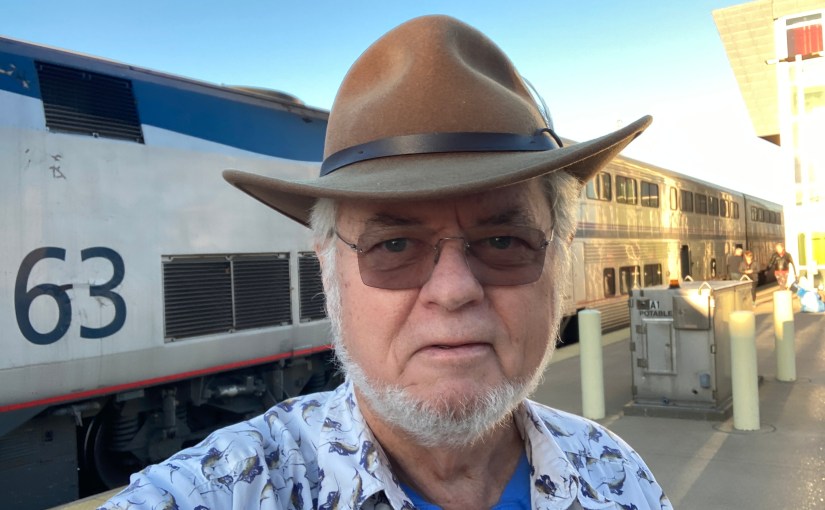
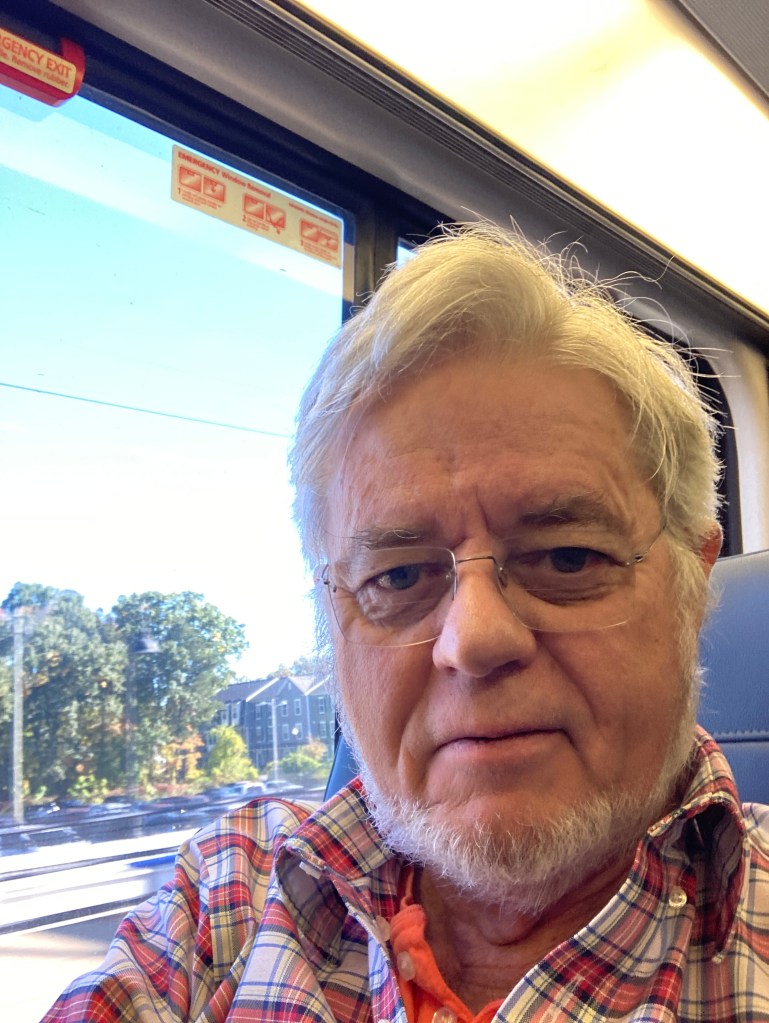
Robin rides in style on the Acela.

Union Station, Washington DC

Tracks here are outside, and the platforms are fairly clean.

Union Station here is built on the same grand scale as in Chicago, with similar shabby adaptations.  The main hall is filled with little concessions.

I have to claim my bags, because the Acela does not have baggage check.  I hire a red cap to run me over to the train.

Train tracks in the station
Red cap loads baggage at Union Station Washington DC.