Sunset Valley to Lake LadyBird

Mostly sunny sky.  Heat forecast.

Stopped at La Madeleine for some orange juice.  Sat at the table and studied the map.  I wanted to cycle from Madeleine to the river without going down a major street—Lamar, Menchaca, S. 1st, S. Congress.

Found two.  I chose one:

Jones Road to Packsaddle Pass.

At Packsaddle Pass, turn left and then to Redd.

At Redd, turn right and to Banister.

At Banister, turn left, after several blocks 

Dogleg right and to Garden Villa.

At Cardinal, turn left and to S. 5th.

At S. 5th, turn left.  Home free.

It would be helpful if Cumberland would connect with Bridgeway.

I had to cross a few major streets, but I never had to ride on one.  All easy neighborhood streets.  On S. 5th, new apartment complexes joined old ones and crowded out more houses.

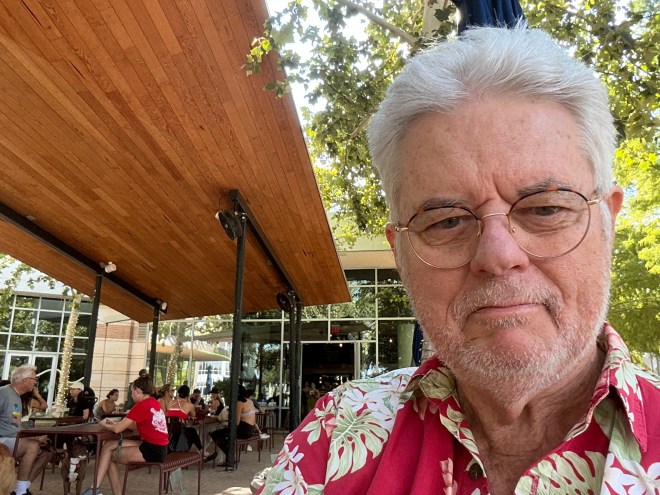
I crossed the river on Pflugerville Bridge, and on the north side I discovered Mañana, an airy cafe with as much outdoors as in, with a long shelter for shade.  The tables are full.  Half the people are chatting with each other, the other half are gazing at their phones.  Families with kids occupy several tables.  One daydreams while her father looks at his phone.

Sunset Valley to Lake LadyBird

Mostly sunny sky.  Heat forecast.

Stopped at La Madeleine for some orange juice.  Sat at the table and studied the map.  I wanted to cycle from Madeleine to the river without going down a major street—Lamar, Menchaca, S. 1st, S. Congress.

Found two.  I chose one:

Jones Road to Packsaddle Pass.

At Packsaddle Pass, turn left and then to Redd.

At Redd, turn right and to Banister.

At Banister, turn left, And after several blocks 

Dogleg right and to Garden Villa.

At Garden Villa, turn left to Cardinal.

At Cardinal, turn left and to S. 5th.

At S. 5th, turn left.  Home free.

Roll down to the river.

It would be helpful if Cumberland would connect with Bridgeway.

I had to cross a few major streets, but I never had to ride on one.  All easy neighborhood streets.  On S. 5th, new apartment complexes joined old ones and crowded out more houses.

I crossed the river on Pflugerville Bridge, and on the north side I discovered Mañana, an airy cafe with as much outdoors as in, with a long shelter for shade.  The tables are full.  Half the people are chatting with each other, the other half are gazing at their phones.  Families with kids occupy several tables.  One daydreams while her father looks at his phone.

Onward by rail

Why do I ride the rails?  First, because it’s the mode of travel that contributes least to the destruction of the natural world. Second, because it’s miles better than the flying torture chambers of the airlines.  Third, because it’s much less work than driving.  Most of all, because it restores romance to the sense of travel. It’s adventure!

I had a hard time sleeping this trip, going north. My insomnia is unpredictable.  My trip going south, crossing different track during the night, I slept well in the roomette.  Can’t say much for sleeping in coach: it’s possible.

Think about all those train stations named Union.  Remember that President Lincoln, while he was wrestling with a civil war, promoted the building of the first coast to coast track that tied the Union together.  We can do it again.

Look for upcoming adventures: 

The rolling stock; The tracks; The politics; The funding; The cost; The alternatives.

The routes, Austin to Providence

Providence is about 1600 miles from Austin.  By air it takes about five hours.  By car it takes about 30 hours.  By train it takes about 60 hours.  That’s three days and two nights.

Take a look at the route map. First, notice that there is a gap in the network along the Gulf Coast. That section was taken out by Hurricane Katrina. It is scheduled for restoration this year. Something the map doesn’t show is that on most routes, the train only runs once a day, and not fast, either. It’s a skeletal system.

To fly between Providence and Austin can cost: basic economy under $200; first class about $500.  To ride between Providence and Austin can cost: coach, under $300; business, up from $300.  Here’s the kicker.  You’re going to be on the train for two nights.  You want a room.  A roomette adds about $500 per night, or $1000.

You can compromise by riding coach one night and sleeper one night.  That’s what I did this trip.  Or, you can fly part way and take the train part way.  I’ve done that, riding the Acela to Washington and flying from there.  That’s pretty easy, and comfortable—a one-day trip, no overnight.  

How about one overnight and a shorter flight?

Here’s something I want to try next.  I could fly to Chicago and ride the sleeper from there.  I like the crew on the Texas Eagle, and I’d like to see them again.  But the tracks have some rough patches.  And the dining is decent but not great. 

Amtrak pulled all the full service diners for all the trains during covid, or so I’m told.  Since then, they’ve restored full service dining to some trains, but not the Texas Eagle.

Or, I could ride the sleeper down to Jacksonville and fly from there.  The Silver Star runs from Washington to Florida.  And the Silver Star has full dining.

The Crescent runs from New York to New Orleans.  If I get off in Atlanta, I can get a direct flight to Austin.   Or, I can ride all the way to New Orleans.  Then the Sunset Limited to San Antonio and the Texas Eagle into Austin.  I don’t know how well the connections match up.  I could fly from New Orleans.

So, there are choices to check out.

Stations along the route

Austin station is an insult to train riders.  This is what you get from a city that gives endless lip service to public transit, but does very little about it.  It’s on the edge of downtown, but it’s hidden away up a hard-to find dead-end street behind the YMCA.  The station itself is underwhelming, with a small inside waiting room and not even the most basic food services.

As we roll north, the conductor announces the stops.  Most are quick.  At some, through-passengers are allowed to get off, stretch their legs, and breathe fresh air or have a smoke.  The conductor offers a wry caution, “When all aboard is called, enter the train.  If you are not on the train when the train leaves the station, you will be left.  That’s all right, you can catch the next train tomorrow.”

At Dallas Union Station, I get off to stretch my legs.  The trainside walkways are pretty nice, red brick edged by that yellow bumpy caution strip.  Little canopies are spaced down the middle.  There are several sets of double tracks.  If I walk down a way, I can get a look at the station building, brick painted while.  A walkway crosses all the tracks and leads to the station, but I don’t want to leave trainside.

At St. Louis Union Station I get off again.  The trainside platform is bare concrete with the yellow edge, but it’s clean.  The tracks are out in the open air, under the sky.  A hulking skyway rises from the platform and crosses other tracks, crosses car traffic, ducks under a raised highway, and disappears.

Second Day on the Texas Eagle

In the morning, about 5:30, I head down to the diner.  Walt has an urn of coffee made at a little station by the stairs, and I draw some into a paper cup as I pass.  The kitchen won’t be open until 6:30.

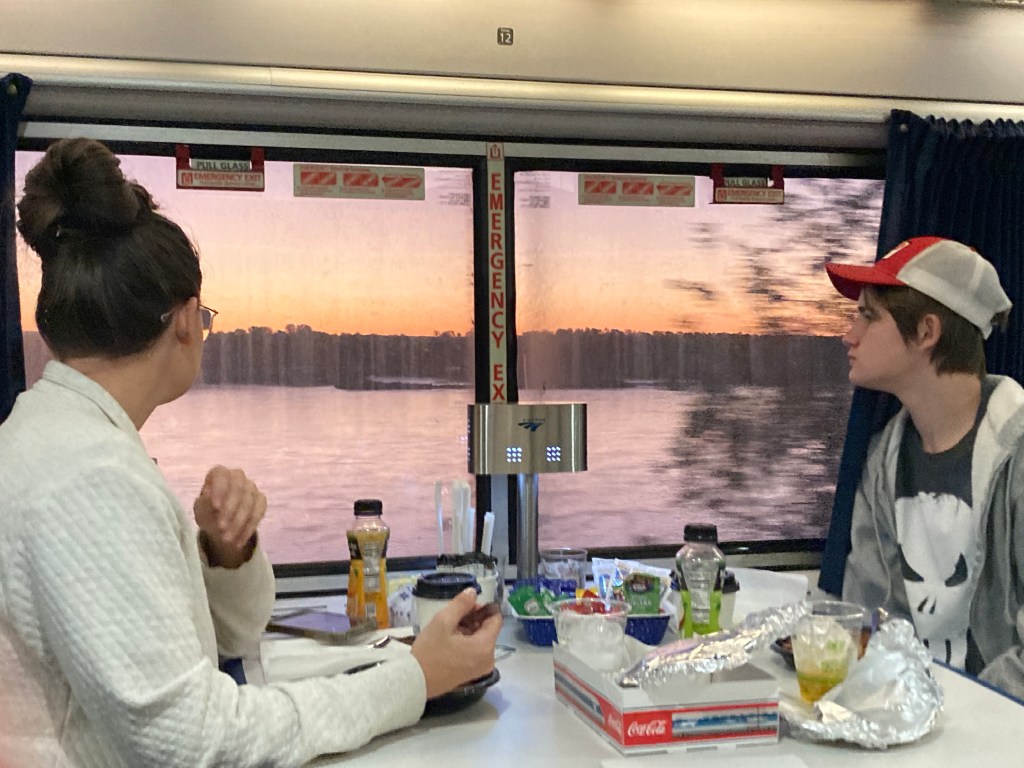
In the diner, I sit down at a table to read the news.  Out the windows to the east, the sun is rising over the Mississippi.  The sky glows a soft orange.

Breakfast comes.  I have an omelet, home fries, and sausage links.  Not bad.

Todd and I talk about the state of the railroad and the way it got this way.  For the first time in decades, there is hope.  Amtrak Joe pumped a tank of billions into the system.  A lot of deferred maintenance will be done, but more difficult is the restoration of a train industry in the U.S. after decades of underfunding.

Lately, during the pandemic, Amtrak cut operations way back.  Then their parts suppliers went out of business.  So now there are no parts to repair the trains.  That’s no way to run a railroad.

After breakfast I retire for a respite in the room.  I make some notes.  I nap a little.  I read a little.  Soon I pick up the macbook and head for the diner.

In the diner, I find the table with my room number on a slip of paper and sit down.  I have at least an hour until lunch.  I open the macbook and start drafting.

Lunch was forgettable.

Amtrak took all the full-service diners off the trains during the pandemic.  After the pandemic, Amtrak did not have enough cars to restore full dining to all trains.  The Texas Eagle was one of the losers.

One thing, the food is plentiful.  You won’t lose weight eating in first class.

Soon after I’m done, I have to vacate the table for the next hungry seating.

Back in my room from lunch, I read a little.  Then I turn myself to organizing and packing for the train change.

I listen to crew members chat as they pack up their rooms.  We’re near the end of the trip.  Everyone on the crew is thinking of the chores they must do to shut down the train.  Their paid time stops when the train stops.  If they’re not finished with their chores, they will finish on their own time.

Goodbye again.

In the sleeper on the Texas Eagle

After supper, I head back to my room.  Actually, it’s a roomette—a little room about 3 x 7 with the corridor on one side and the windows on the other.  Two little bench seats face each other.  There’s a tiny pullout table, but I don’t pull it out, much.  The seats pull out to a recliner, and I do pull those out.

The upholstery and wall coverings are dark royal blue, which makes the room dark, and the lights are barely adequate.  I lean back, with a pillow under the small of my back, reading a novel.

Walt, the sleeper man, comes by to ask me when I want my bed turned down.  The two seats make into a lower bunk, and an upper bunk pulls down from the ceiling.  I’m alone, so I only need the lower bunk made up.  I ask him to put out some towels, so I can take a shower, and he says he will.

The roomettes share a shower downstairs.  The full rooms have showers and toilets in suite.  I can’t afford a full room.  I’d like to, but no can do.

I don’t spend a lot of time in the roomette.  It’s cozy, but close.  One interesting feature: the room doors cannot be locked or even latched from the outside.  And frequently, as the train speeds up and slows down, the doors slide open.  It’s not unusual to come back to your room and find the door open.  Don’t worry, it’s just the rocking of the rails.

The train generally runs between pretty smooth to a little shaky, but sometimes it veers into wobbly or even jerky.  When it’s jerky, that interdimensional space between the cars can raise your hackles, as the car behind you lurches left while the car before you lurches right.

I decide to take a quick shower and change into my jammies.  The shower room is a small cubicle, with another cubicle for undressing and dressing.  Walls are drab gray vinyl.  The shower head is on a wand, the water pressure is good, and the water is plenty hot.

I get back to my room in time for Walt to come by and make my bunk.  I settle in with a book.  The overhead light is really poor, and the reading light casts a glare.  I brought a lantern, but it’s in my rolling bag downstairs.  To hell with it.

I punch off the lights and close my eyes.  First, I punch the call button for the attendant.  I don’t want the attendant, but the call button is next to the light switch, so I punch it by mistake.  I punched the call button by mistake in the toilet and the shower, too.  I felt like a nuisance, but the attendant never came, so I stopped worrying about it.

Soon I notice that the car is repeatedly jerking and bucking, tossing me back and forth in the bed.  This doesn’t help my insomnia.  We’ve run into some bad track.  And we keep running on bad track most of the night.  I sleep in short dozes.  Finally, about 5:30, I get up and get dressed.

Spring day on Wolf Mountain

Sunday I spent some solitary time on Wolf Mountain. It was just a few days after the equinox, and I generally try to get a day of solitude around each turn of the seasons.  Wolf Mountain is a favorite place to go for spring.

It’s not really an impressive mountain.  It only rises about 200 feet from the lands below, and the trail makes a very gradual ascent.  It’s set in the karst topography of the Central Texas Hill Country, so it’s arid and rocky, mostly covered by oak and juniper, and cut by a few perennial creeks that make short sharp dashes down to the Pedernales River.

Wolf Mountain is the high point of Pedernales Falls State Park, about 40 miles west of Austin off U.S. Hwy 290.  You drive through Dripping Springs and Henly on the way. When I say it’s off 290, I mean turn north onto Ranch Road 3232 and drive seven miles to the entrance.  Then drive a couple more miles to the ranger station.

The trailhead for Wolf Mountain Trail is about a quarter mile from the ranger station, and it has it’s own little parking lot. I couldn’t count the number of times I’ve parked there and hiked that trail.  Often I hiked it alone, but sometimes I hiked it with my father or my brother or both.

Wolf Mountain Trail is a loop of somewhere between six and eight miles, depending on which reference you’re reading.  It used to be just a foot trail, maybe an old cattle trail, until about 20 years ago, when someone got injured on the mountain. After that the parks department laid down an ambulance-wide gravel roadbed.

I love to hike the trail in the spring, not so much in the summer.  There is a fairly level stretch of maybe a mile, just past Regal Creek, that is swarming with horseflies in the summer.  They are mean, and they are tough.  Walk along that trail with sweat running down inside your shirt, and they will attack you.  The times I’ve hiked along there in the summer, I would hold a red bandanna by the corner, shake it out, and switch it across my back constantly, the way a horse switches his tail across his back.

If you slap one of those horseflies and he falls to the ground, step on him.  Otherwise he will shake himself off, buzz away, and then head right back at you.

Just after you cross Mescal Creek, on the shoulder of the mountain, the primitive campgrounds are laid along the bluff overlooking the creek and the river.  It’s beautiful in there.

My Daddy and I had a favorite campsite in there under a sort of vaulted ceiling formed by the tree canopy.  Just a few steps away a rock ledge overlooked the creek and gave a western exposure.  After supper we would sit out on that rock ledge, which we called the veranda, and watch the sun go down over the far ridge.

A steep scramble below the veranda, Mescal Creek forms a beautiful little blue pool.  In wet times, it’s deep enough to come up to your chin, and broad enough for a stroke or two.  It will keep a can of beer fairly cold.

I remember one winter night I was camping there by myself.  It was pretty cold after dark, but I didn’t want to crawl into the tent at 7 pm, so I bundled up and sat on the dirt against a big tree.  I hung my lantern on a twig above my head.  The lantern made a circle of light around me that stretched out about ten feet across the dirt.

Just outside the lantern light various critters, bugs mostly, came to take a look.  I noticed a good-sized scorpion, stinger curled up over his back, come right up to the edge of the light and just stay.  I don’t know if he was looking at me, but he was aimed right at me. He stayed still for a couple of hours. I was writing in my journal, but I don’t mind saying that scorpion affected my concentration.  I lost track of my thoughts a time or two, but I never lost track of where that scorpion was.  Eventually, he left.  I didn’t ask him where he was going.

Not far past the primitive campground, the trail forks, the left fork going around by the river bluff and Jones Springs, and the right fork going directly up the mountain.  The trail doesn’t go to the peak, but forms a circle around it, with the direct fork coming in on one side and the Jones Springs fork coming in on the opposite side.  The first time we hiked that loop, Daddy and I must have circled at least twice before we realized what we were doing and burst out laughing.  Now there’s a sign pointing to the parking lot, so that foolishness has been solved.

The loop there around the peak is where I went to cry after my father died.  Last Sunday I sat in the spot and ate a sandwich and wrote a few rough lines of poetry.  I still have more work to do on that.

The sky had been overcast when I started up the mountain, but when I arrived there on the upper loop, the blue was breaking through.  There’s a ridge to the west, but to the north, where the trail meanders down, the rough beauty of the Hill Country landscape rolls out toward the horizon.